

Hemp Buyers in the US: Who Buys Industrial Hemp Fiber and Grain
Who are the hemp buyers in the US for fiber and grain?+
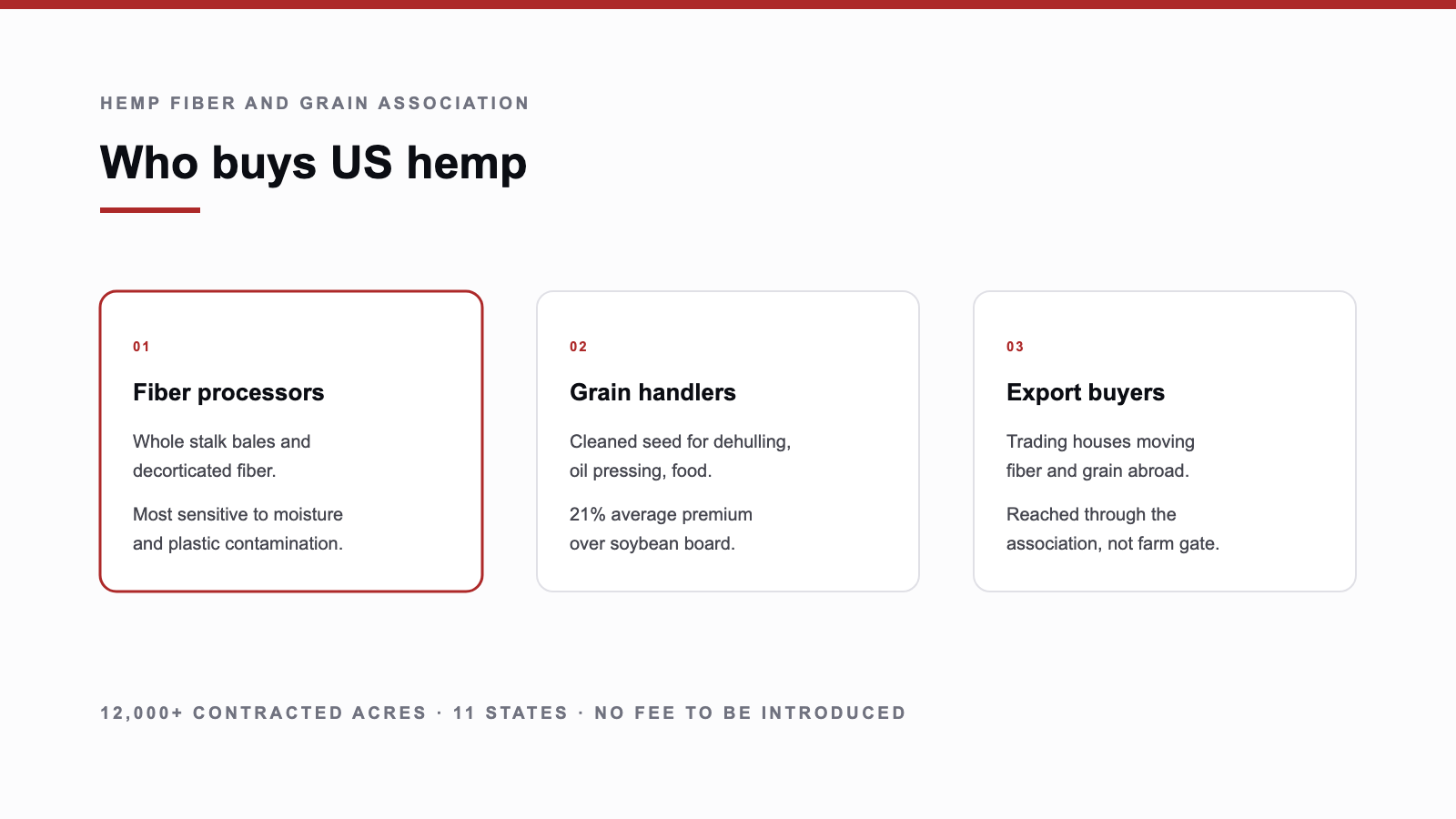
Hemp buyers in the US are mainly fiber processors, grain handlers, and export buyers — each purchasing different crop fractions against different specs, reachable through free HFGA introductions.
The question every new grower asks before planting an acre is the right one: who actually buys this? Hemp buyers in the US exist, they buy under contract, and they are reachable — but they are not one audience. Fiber processors, grain handlers, and export buyers purchase different fractions of the same crop against different specifications.
Industrial hemp fiber and grain are non-psychoactive crops grown under the 2018 Farm Bill at or below 0.3% delta-9 THC. Hemp buyers in this market are industrial purchasers — mills, decorticators, food processors, trading houses. None of this concerns CBD or marijuana.
What Hemp Buyers in the US Actually Purchase
A hemp buyer does not purchase "hemp." They purchase a defined fraction at a defined moisture, in a defined bale format, with paperwork attached. Whole stalk bales, decorticated fiber, hurd, and cleaned grain are four different products from one field, and most buyers want exactly one of them.
The paperwork matters as much as the material. A licensed producer number, the pre-harvest cannabinoid test, the seed lot, and a moisture record are what turn a bale into something a buyer can put through a contract. The association's standards library exists so that both sides describe the same bale in the same terms rather than negotiating vocabulary at the scale house.
Growers who understand this stop asking "what is hemp worth" and start asking "what is this grade worth to this buyer" — which is a question with an answer.
That shift also changes how a season is planned. Fiber destined for a textile processor is retted, baled, and stored differently from fiber headed for insulation. Deciding which hemp buyer you are growing for before the drill goes in the field is worth more than any agronomic adjustment made afterwards.
The Three Types of Hemp Buyers
Nearly every serious purchaser in the US falls into one of three groups.
Hemp Fiber Processors and Decorticators
These buyers take whole stalk bales or already-decorticated fiber and separate bast from hurd at industrial scale. They are the most sensitive to moisture and contamination, because wet stalk fouls a line and plastic bale wrap fed through a decorticator shreds into the fiber and cannot be removed afterwards.
Fiber processors are the entry point for most first-time growers, and they are the buyers most likely to contract acres ahead of planting.
Hemp Grain Handlers and Food Brands
Grain buyers purchase cleaned seed for dehulling, oil pressing, and food ingredients. Their requirements are moisture, variety, and clean handling — food-grade destinations bring storage and segregation expectations that fiber does not.
Grain is where the premium has been most consistent: across the association's network, hemp grain has averaged a 21% premium over soybean board pricing, which is what makes a dual-purpose crop pencil.
Export Hemp Buyers and Trading Houses
International demand for US-grown fiber and grain is real, and export buyers work through trading houses rather than farm-gate purchases. The association works directly on export market access, and the background on tariff exposure is covered in our analysis of trade tariffs. USDA FAS publishes the trade data worth watching before committing acres to an export program.
How to Reach Hemp Buyers Without Paying a Broker
There is no reason for a grower to pay for an introduction. Here is the path that works.
Get Introduced Through the Association
The Hemp Fiber and Grain Association connects growers to vetted buyers at no charge — no membership, no commission, no per-tonne fee. That network currently spans 12,000+ contracted acres across 11 states. The starting point is the sell your crop page, and the introduction costs nothing because unconnected growers are the bottleneck this industry has, not a revenue opportunity.
Meet the Spec Before You Call a Hemp Buyer
Hemp buyers in the US turn down more lots for moisture and contamination than for anything agronomic. Bale at or below 15% moisture, store under cover and off the ground, and remove all wrap and twine before material goes to decortication. Those three habits determine whether a first sale becomes a second one.
Reading the textile standard before harvest is a faster education than any conversation after it.
Contract Ahead of Planting Where You Can
A contract before seed goes in the ground removes the question this article started with. Contracted acres are how the association's network is structured, and it is why derisking a first hemp crop starts with the buyer rather than the agronomy. Certified seed from a vetted supplier, certified under the AOSCA framework, is the other half of that conversation.
Regulatory questions about licensing are answered by USDA AMS and your state Department of Agriculture. Everything else — who buys, at what grade, for what price — the association will walk through with you at no cost.
FAQ
Quick answers from this article.
Do US hemp buyers purchase a generic hemp crop?+
No. They buy a fraction: whole stalk, decorticated fiber, hurd, or cleaned grain, at a stated moisture, in a stated package, with paperwork.
Who are the three main US hemp buyer groups?+
Fiber processors and decorticators, grain handlers and food brands, and export buyers working through trading houses. Most want only one fraction.
What premium has network hemp grain shown against soybean?+
Across the association network, hemp grain has averaged a 21 percent premium over soybean board pricing. That is a network figure, not a USDA board price.
What handling habits do fiber buyers reject first?+
Moisture and contamination. Bale at or below 15 percent moisture, store under cover off the ground, and remove wrap and twine before decortication.
Does HFGA charge for a buyer introduction?+
No. Introductions have no membership, commission, or per-tonne fee. The network cited here spans 12,000-plus contracted acres across 11 states.