

The Hemp Fiber Market: Demand, Pricing, and Where US Growers Fit
Where do US growers fit in the hemp fiber market?+
US growers fit the hemp fiber market by pricing bast, hurd, and grain separately against textile, construction, and food buyers — preferably under contract — rather than treating the crop as one commodity.
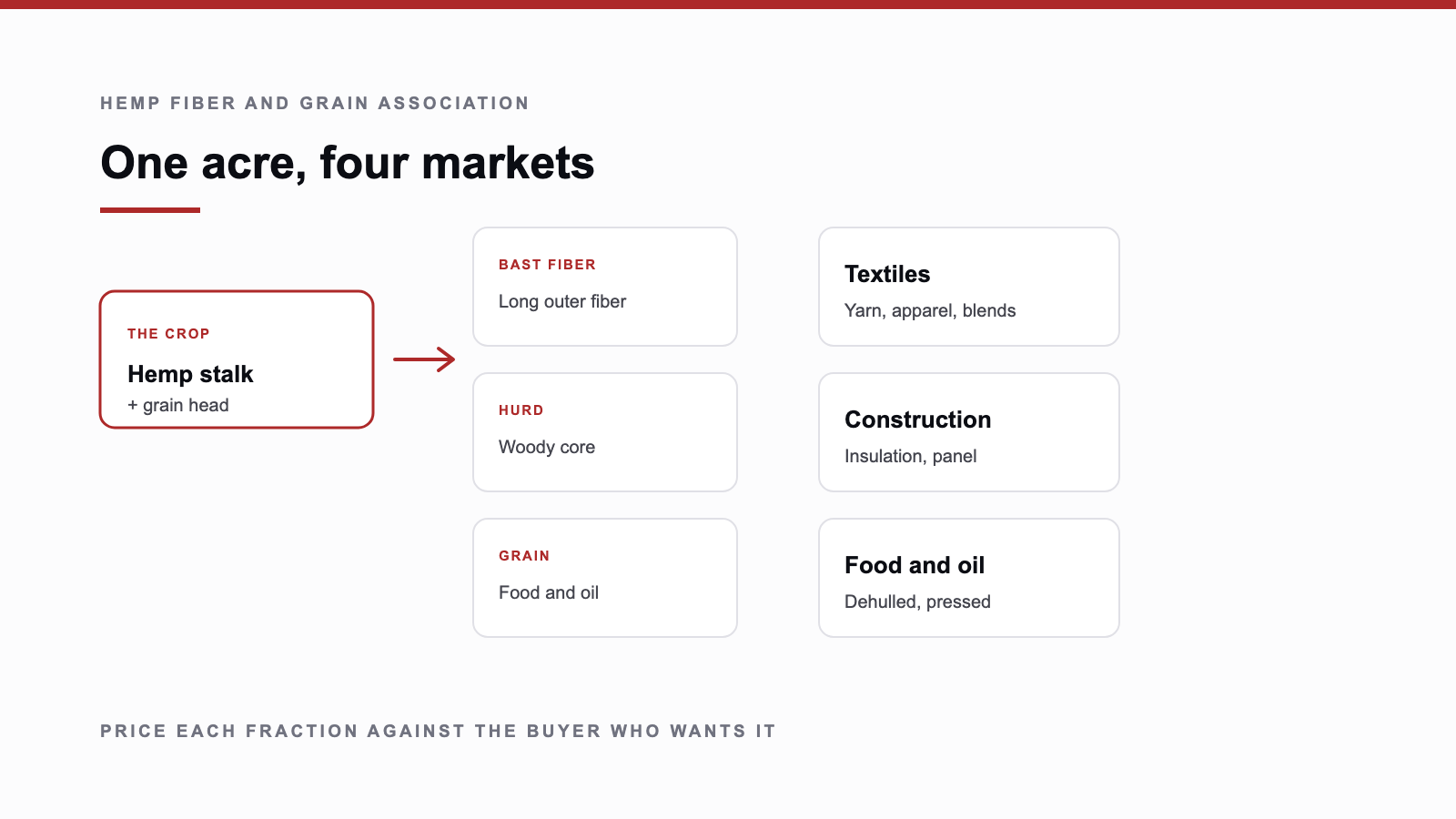
The hemp fiber market is not one market. A single acre produces bast fiber, hurd, and — on a dual-purpose crop — grain, and each fraction sells into a different buyer with a different specification and a different price. Growers who treat it as one commodity leave money on the table. Growers who understand the split price each fraction against the buyer who actually wants it.
Industrial hemp here means fiber and grain varieties grown under the 2018 Farm Bill at or below 0.3% delta-9 THC. It is not CBD and not marijuana. The crop looks like hay in the field, plants with a grain drill, and harvests with equipment most row-crop farms already own.
Where the Hemp Fiber Market Stands Today
The honest answer for any grower asking about the hemp fiber market is that acreage and price data are published, and you should read them rather than take anyone's word for it. USDA NASS publishes the National Hemp Report with acreage, production, and value by state, and USDA AMS maintains the regulatory framework every licensed producer operates under.
What the Hemp Fiber and Grain Association can speak to directly is its own network. As of 2024 that network covered more than 12,000 contracted acres across 11 states, with over 8,000 tons of fiber and 1,200 tons of grain processed. Hemp grain in that network has averaged a 21% premium over soybean board pricing.
Those are network figures, not national ones. They are useful because they represent contracted acres — fiber and grain grown against a buyer commitment rather than into a spot market that may or may not exist at harvest. That distinction matters more than any headline market-size projection.
Projections are worth reading and worth discounting. A grower cannot bank a forecast. What a grower can bank is a signed contract, a certified seed lot, and a buyer who has taken delivery before. The hemp fiber market rewards the growers who secure those three things ahead of planting, in that order.
What Drives Hemp Fiber Market Demand
Demand does not come from a general enthusiasm for hemp. It comes from three specific industries with three specific requirements, and a grower's agronomy decisions determine which of them can buy the crop.
Textiles Pull the Hemp Fiber Market Upstream
Textile buyers want long bast fiber that spins. That means fineness, length, low residual hurd, and — critically — no synthetic contamination from bale wrap fed through a decorticator. Textile demand is the most specification-sensitive end of the hemp fiber market and generally the best paying, because a spinner cannot substitute a coarse bale for a fine one.
This is why the association publishes the HFGA US Hemp Textile Standard, which defines what a textile grade means so that a grower, a processor, and a mill describe the same bale the same way.
Construction and Composites Absorb the Rest of the Hemp Fiber Market
Not every acre produces textile-grade fiber, and it does not need to. Hurd and shorter fiber move into insulation, fiber-reinforced panel, hempcrete, and polymer composites. These buyers tolerate coarser material and higher hurd content, which makes them the reliable floor under a fiber crop.
The HFGA US/EU Decorticated Fiber Standard grades this material once and maps each grade to its downstream routes, so a bale that misses a textile spec still has a documented home.
Grain Revenue Stabilizes a Dual-Purpose Crop
Dual-purpose crops harvest grain first and bale the straw behind it. Grain sells into food and oil markets, and the straw still carries fiber value. That second revenue line is what makes the hemp fiber market workable on farms that cannot bet a whole field on one buyer.
How US Growers Enter the Hemp Fiber Market
Entering is less about market timing than about three decisions made before planting.
Enter the Hemp Fiber Market With Certified Seed and a Contract
Certified seed of a documented variety is the precondition for every downstream claim. Varieties are certified under the framework maintained by AOSCA, and the association introduces growers to certified seed suppliers at no cost. A contract before planting converts a speculative acre into a known one.
Know Your Grade Before You Bale
Moisture at baling, wrapper removal before decortication, and storage under cover determine which grade a lot can reach. These are handling decisions, not equipment purchases, and they separate a textile-grade bale from a construction-grade one.
Price Against Corn and Soybean, Not Hope
Hemp competes for acres against known crops, so it should be priced against them. The association publishes fiber and grain pricing references, and the comparisons against corn and soybean economics are the right starting point. Growers planting behind winter wheat have seen roughly +$215 per acre from a second crop on ground that would otherwise sit.
When the numbers work, the next step is connecting with a buyer. That introduction is free, and it is the whole reason the association exists.
FAQ
Quick answers from this article.
Is the hemp fiber market one commodity price?+
No. One acre can yield bast, hurd, and on a dual-purpose crop, grain. Each fraction has its own buyer, spec, and price.
What HFGA network numbers describe contracted hemp acres?+
As of 2024 the network covered more than 12,000 contracted acres in 11 states, with over 8,000 tons of fiber and 1,200 tons of grain. Grain averaged a 21 percent premium over soybean board pricing.
Which hemp fiber buyers pay for the tightest spec?+
Textile buyers. They want long bast, low residual hurd, and no synthetic contamination from bale wrap. Coarser fiber and hurd move to construction and composites.
What can a grower bank in the hemp fiber market?+
A signed contract, a certified seed lot, and a buyer who has taken delivery before. A forecast is not a bankable price.
Where are official US hemp acreage figures published?+
USDA NASS publishes the National Hemp Report with acreage, production, and value by state. USDA AMS holds the licensing framework.