

The Essential Role of Associations: The Industrial Hemp Fiber Association
Why does industrial hemp need a hemp fiber association?+
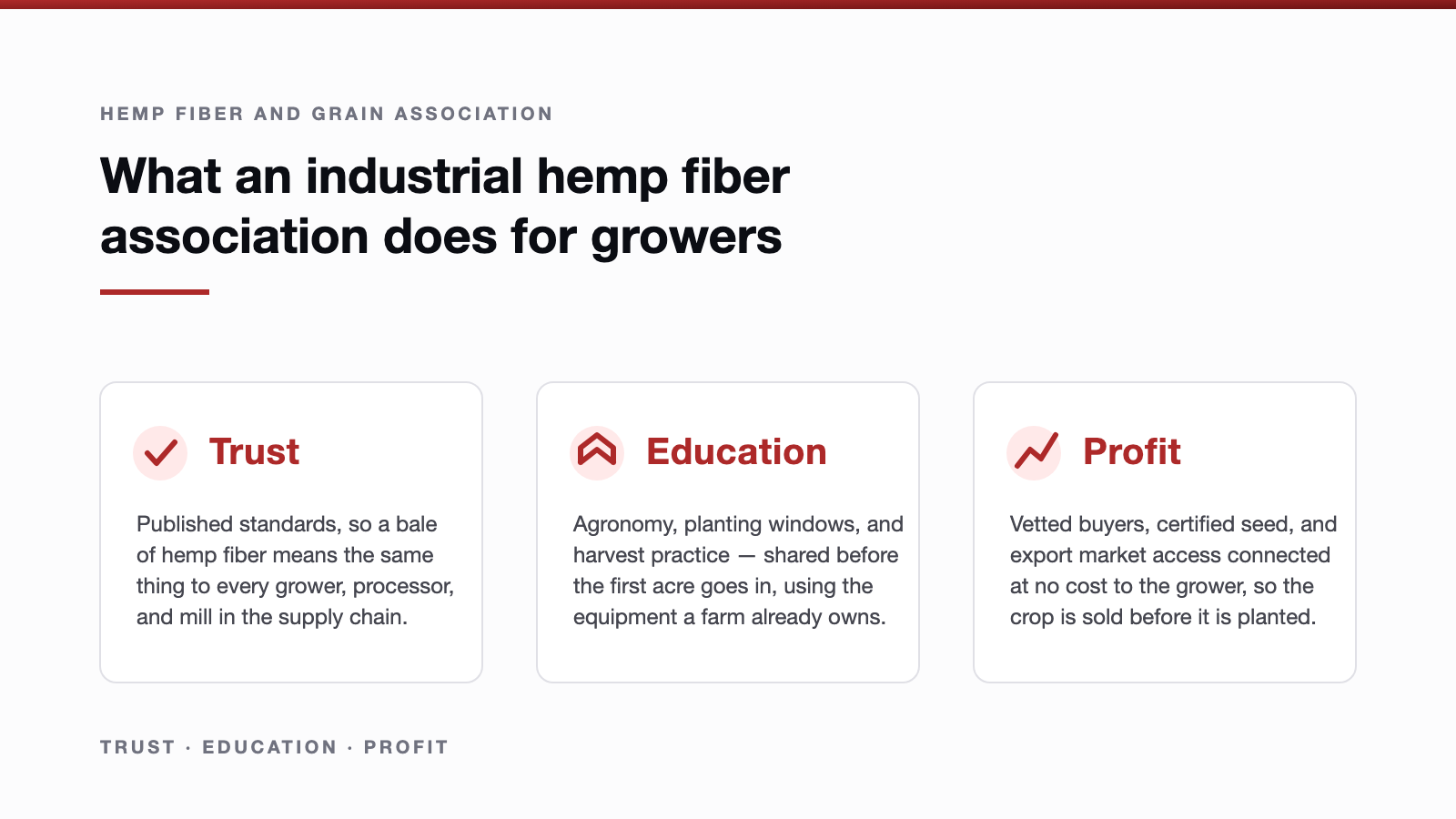
Industrial hemp needs a hemp fiber association because shared standards, certified seed, vetted buyers, and export access are connective tissue no single farm can create alone — delivered at no cost to the grower.
Corn has a hundred years of infrastructure behind it. A grower knows the grade, the moisture discount, the basis at the local elevator, and roughly what the crop is worth before the planter leaves the shed. Industrial hemp has almost none of that yet — and the gap is not agronomic. Farmers can grow hemp fiber and grain successfully with the equipment already parked in the machine shed.
What is missing is the connective tissue: a shared definition of quality, a route to a buyer, and a way to price the crop with confidence. That connective tissue is what an industrial hemp fiber association is for. It is the difference between a promising crop and a market a lender will underwrite.
First, a clarification that still needs making. Industrial hemp is not marijuana. Fiber and grain hemp are non-psychoactive, federally legal under the 2018 Farm Bill, and grown under USDA's Domestic Hemp Production Program at or below 0.3% THC. The crop in these fields looks like hay or soybean, not cannabis.
Why an Industrial Hemp Fiber Association Exists
New markets fail in predictable ways. A grower plants without a contract and has nowhere to deliver. A processor receives four loads from four farms and finds four different products in the trailer. A brand wants to buy American hemp fiber but cannot write a purchase spec because no agreed spec exists.
None of those failures are caused by bad farming. They are caused by the absence of shared reference points — and no single farm, processor, or buyer can create those alone. A grower cannot unilaterally define what "clean fiber" means. A processor cannot certify its own seed supply and expect a buyer to take its word for it.
This is the classic case for an association: work that benefits everyone, that no one participant can profitably do by themselves. The Hemp Fiber and Grain Association exists to carry that work — and to hand the results to growers for free. Across 11 states the network now covers more than 12,000 contracted acres, with 8,000+ tons of hemp fiber and 1,200+ tons of hemp grain processed. Those numbers are the product of coordination, not of any one operation getting bigger.
What an Industrial Hemp Fiber Association Does for Growers
The work divides into three jobs, mapping onto the association's three commitments: Trust, Education, and Profit. Each one closes a specific gap that costs farmers money today.
Setting Hemp Fiber Standards So a Bale Means the Same Thing Everywhere
A grade name is only useful if it means the same thing in Michigan and in Milan. That is why the association publishes open technical standards covering hemp fiber quality, contamination limits, and field-to-bale traceability.
The standards are free to read and free to conform to. There is no membership fee, no audit fee, and no per-tonne royalty. A conformity claim attaches to a specific tested lot rather than to a company, which means a first-season grower and a large processor are judged by the same measured numbers.
Why this matters commercially: a buyer who can specify a grade can write a contract. A buyer who cannot, discounts for uncertainty — and that discount comes out of the farmgate price.
Connecting Hemp Fiber Growers to Certified Seed and Vetted Buyers
Seed choice determines yield, and it determines compliance. The association introduces growers to certified seed producers whose varieties are regionally tested and documented, in line with the seed certification framework maintained by AOSCA. Imported seed of unknown provenance carries real risk: poor germination, and THC results that put a crop out of compliance at harvest.
The other half is the buyer. The association connects growers directly to vetted processors and offtake partners before planting, at no charge. The order matters. A hemp crop should be sold before it goes in the ground, which is the same principle covered in our guide to derisking hemp fiber and grain for new farmers.
Opening Export Markets for US Hemp Fiber
Domestic processing capacity is growing, but it is not yet the whole market. Export demand for US-grown hemp fiber and grain is real, and reaching it requires paperwork, documentation, and buyer relationships that individual farms are not positioned to build.
The association works on export market access on the industry's behalf, using trade data published by the USDA Foreign Agricultural Service. A wider set of buyers means less exposure to any single processor's contracting decisions in a given season.
What the Hemp Fiber Association Means for Your Operation
For an individual farm, the value of an association is measurable in three places: what you know before planting, what you can expect at delivery, and whether anyone is representing your interests when rules are written.
Education Before the First Acre Is Planted
Most hemp mistakes are made before planting. Wrong variety, wrong seeding rate, wrong field, wrong expectations about harvest timing.
The association publishes agronomy guidance covering spring planting and the double-crop window behind winter wheat, which has returned roughly +$215 per acre for growers already running a wheat rotation. Our frequently asked questions covers the practical ground — equipment, legality, and what the crop smells like — because those questions come up before agronomy does. State Cooperative Extension services remain an excellent second source for region-specific trial data.
Price Transparency for Hemp Fiber and Grain Contracts
A farmer cannot evaluate a hemp contract without a reference point. The association maintains hemp fiber and grain pricing references so growers can judge an offer against something other than the offer itself.
Hemp grain has been averaging a 21% premium over soybean, and hemp fiber economics compete with corn on comparable ground. Those figures only become bankable when a grower can check them independently — and when yield and acreage data land in USDA-NASS surveys alongside every other row crop.
A Seat at the Table on Policy and Research
Rules for a young crop get written whether or not farmers are in the room. THC testing windows, sampling protocols, crop insurance treatment, and research funding all shape what hemp costs to grow.
An industrial hemp fiber association aggregates the grower voice into something regulators and researchers can actually work with, and directs attention toward agronomy questions that matter in the field — nitrogen response, variety performance, harvest timing. That work compounds: every season of trial data makes the next season's decisions cheaper.
None of it requires a fee from the farmer. Every introduction — seed, buyer, export — is delivered at no cost. If you are weighing hemp fiber or grain for the coming season, start with the planting guides and let us line up the buyer before you commit an acre.
FAQ
Quick answers from this article.
What is missing for hemp that corn already has?+
A shared grade, a moisture discount, and a basis a lender can underwrite. The gap is market infrastructure, not the ability to grow the crop with existing equipment.
Are HFGA standards free of a royalty?+
Yes. They are free to read and free to conform to, with no membership fee, no audit fee, and no per-tonne royalty. A conformity claim is on a tested lot.
Why does the association want the crop sold before planting?+
A hemp crop without a contract has nowhere to go. Introductions to vetted processors are at no charge, and the order is buyer first.
What network scale does the article cite?+
More than 12,000 contracted acres across 11 states, with 8,000-plus tons of fiber and 1,200-plus tons of grain processed.
Is industrial hemp marijuana?+
No. Fiber and grain hemp are non-psychoactive, legal under the 2018 Farm Bill, and grown at or below 0.3 percent THC.