

Federal Hemp Definition Changes December 11, 2026: What Fiber and Grain Growers Should Check
What does the federal hemp definition change on December 11, 2026 mean for fiber and grain growers?+
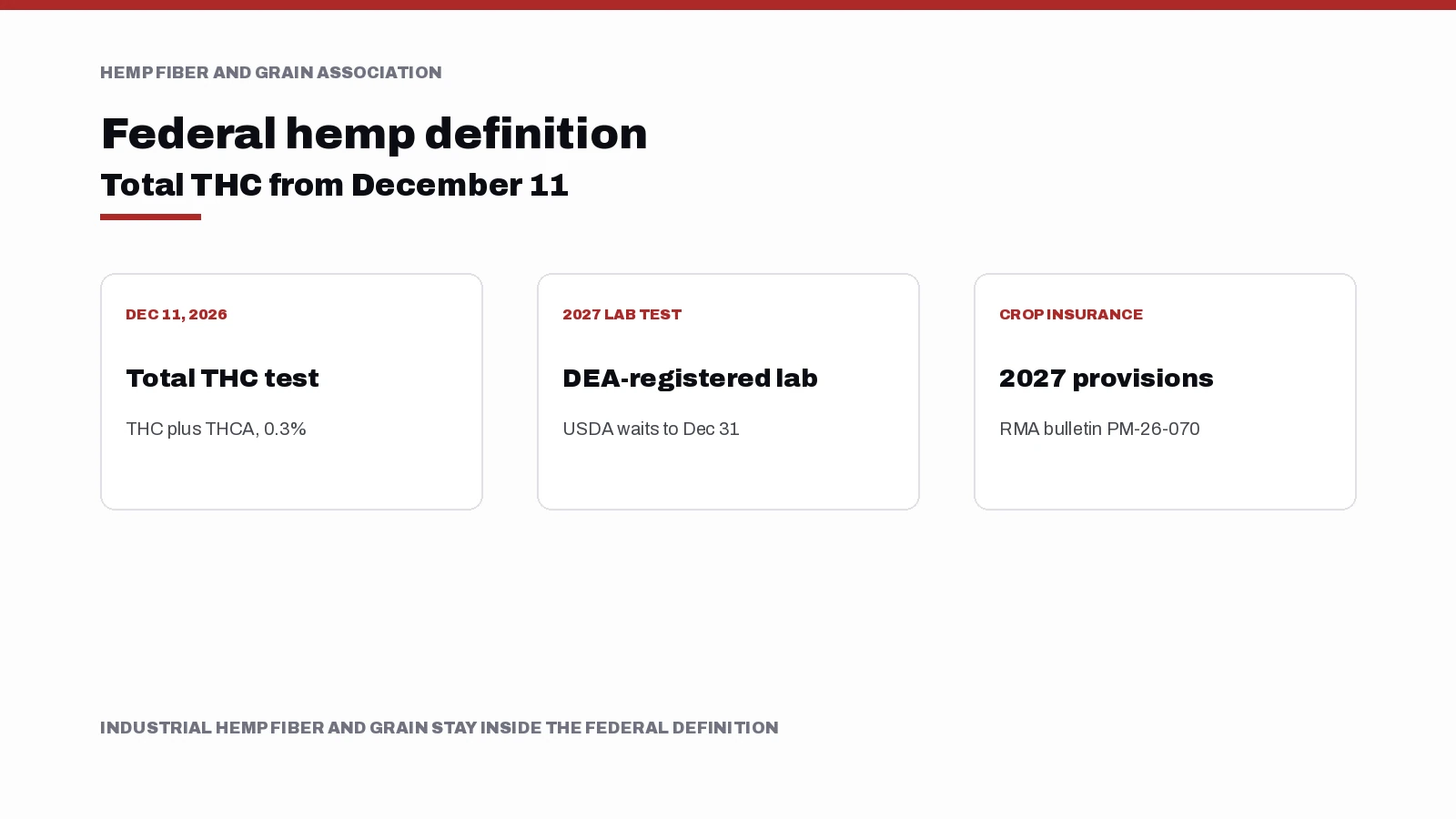
Industrial hemp grown for stalk, fiber, grain, oil, cake, nut or hull stays inside the federal hemp definition. The test moves from delta-9 THC to total THC including THCA, still capped at 0.3 percent dry weight, so growers should confirm license, lab and seed paperwork.
The federal hemp definition changes on December 11, 2026, and industrial hemp grown for fiber or grain stays inside it. The measuring stick moves from delta-9 THC to total THC, which counts THCA as well, and the cap stays at 0.3 percent on a dry weight basis. Industrial hemp is not marijuana: fiber and grain hemp is non-psychoactive, and this change is aimed at intoxicating hemp-derived consumer products, not at your acres. Still, a new definition means paperwork to confirm before you order seed for 2027. This article is education, not legal advice. Your state agriculture department or USDA license terms control your farm.
What Changes on December 11, 2026
Congress rewrote the definition of hemp in the FY2026 agriculture appropriations law, Public Law 119-37, signed November 12, 2025. The new text was set to take effect 365 days later, on November 12, 2026. A later continuing resolution, Public Law 119-103, delayed most of it. According to the Congressional Research Service, only the exclusion for products made with cannabinoids a cannabis plant cannot naturally produce took effect on November 12, 2026. The rest of the new definition starts December 11, 2026.
The core sentence of the amended statute sets hemp as Cannabis sativa L. with a total tetrahydrocannabinols concentration, including tetrahydrocannabinolic acid, of not more than 0.3 percent on a dry weight basis. The old text counted only delta-9 THC. The law also adds exclusions for intoxicating cannabinoid products, including a cap of 0.4 milligrams of total THC and similar cannabinoids per retail container. Those product limits matter to the consumer hemp market. They are not a field standard for a fiber or grain crop.
The December 11 date is not guaranteed to be final. The CRS notes that other bills would delay the definition again or repeal it. Watch your state program and the HFGA frequently asked questions before you lock in a plan.
What the Federal Hemp Definition Means for Fiber and Grain Acres
The short answer for a farmer growing for fiber or grain is that your crop category is written into the law. The questions that remain are about testing, seed and paperwork, not whether you can plant.
Industrial hemp is named in the law
The amended statute says the term hemp includes industrial hemp, and it defines industrial hemp by use. That covers hemp grown for the stalk, for fiber produced from the stalk, and for the whole grain, oil, cake, nut or hull of the seed. A fiber grower following the spring planting guide or a grain grower after the winter wheat window is growing a named category. A buyer reading a contract will look for that same language.
Total THC is already how USDA licensees are tested
For growers under the USDA program, the testing math is familiar. USDA's producer rules in 7 CFR Part 990 report THC after decarboxylation, meaning THC plus THCA, and require a sampling agent to collect samples within 30 days before the anticipated harvest. State and tribal plans have their own details. The new statute uses the broader phrase total tetrahydrocannabinols, so ask your state agency or USDA whether its procedure or report form changes. We did not find a published USDA rule update on the topic as of this writing.
Seed above the threshold is excluded
The amended definition excludes viable seed from a plant that tests above 0.3 percent total THC. For a farmer, the practical point is the seed tag and the parent lot. HFGA's guide to reading a certified hemp planting seed tag walks through the paperwork, and the page on buying certified hemp seed covers sourcing. Keep the tag with the field record from the day you plant.
What to Do Before the 2027 Season
You do not need to change your rotation because of this definition. You do need three confirmations while you plan, and winter is the right time to make them.
Check your license and your lab
Industrial hemp growers still need authorization from a state, tribal or USDA program. USDA's Agricultural Marketing Service says it is delaying until December 31, 2026 the enforcement of a requirement that hemp be tested by a laboratory registered with the Drug Enforcement Administration. The AMS hemp page shows the current notice. Unless USDA extends the delay again, plan on a DEA-registered lab for 2027 samples, and ask your program which labs it accepts.
Check your crop insurance
On November 18, 2026, USDA's Risk Management Agency issued bulletin PM-26-070. It says hemp provisions are updated for the 2027 crop year to align allowable THC levels with the amended law, and the new provisions are due by November 30, 2026 on the RMA website. RMA's summary of the 2027 hemp provisions says cancellation and termination dates now sit in the Special Provisions, and that THC levels over the statutory limit are an uninsured cause of loss. Ask your agent for the 2027 hemp provisions and read both.
Check your buyer and your records
Buyers are reading the same news and may update contracts. Before you sign, ask whether the contract tests for delta-9 THC or total THC and who pays for a retest. Keep the license number, parcel, variety, seed lot, planting date, harvest date and lab report in one file. If you are lining up a home for the crop, the page on selling your hemp fiber and hemp grain crop explains how HFGA connects growers with buyers at no cost, and the US hemp textile standard shows what one fiber standard asks a grower to document.
FAQ
Quick answers from this article.
Does the new hemp law ban industrial hemp fiber or grain?+
No. The amended definition names industrial hemp, including hemp grown for stalk, fiber, whole grain, oil, cake, nut and hull. The bans in the law target hemp-derived cannabinoid products, not fiber or grain crops.
What is total THC and why does it matter at harvest?+
Total THC adds THCA to THC, because THCA converts to THC with heat. The federal limit stays at 0.3 percent on a dry weight basis. USDA's producer rules already test after decarboxylation, and state programs can differ.
Which date applies to my farm, November 12 or December 11, 2026?+
December 11, 2026 starts the rest of the amended definition, including the total THC test. November 12, 2026 applied only to the exclusion for products made with cannabinoids a plant cannot naturally produce.
Do I need a DEA-registered lab for my 2027 hemp test?+
USDA says it will not enforce the DEA-registered laboratory requirement until after December 31, 2026. Unless USDA extends that again, plan on a DEA-registered lab for 2027 and ask your state program.
Will crop insurance for hemp change for 2027?+
USDA's Risk Management Agency announced on November 18, 2026 that hemp crop insurance provisions are updated for 2027 to align allowable THC levels with the amended law. Ask your agent for the 27-1218 provisions.