

Imperium Fiber Becomes the First Product Registered to the HFGA US Hemp Textile Standard
What does Imperium Fiber's registration to the HFGA US Hemp Textile Standard mean?+
Imperium Fiber is the first product registered against the HFGA US Hemp Textile Standard at Grade TX-A — a public declaration, not a conformity claim, until lot verification exists under the scheme rules.
Heartland Industries has registered Imperium Fiber as the first product in the Hemp Fiber and Grain Association's public registry, declared against the HFGA US Hemp Textile Standard at Grade TX-A.
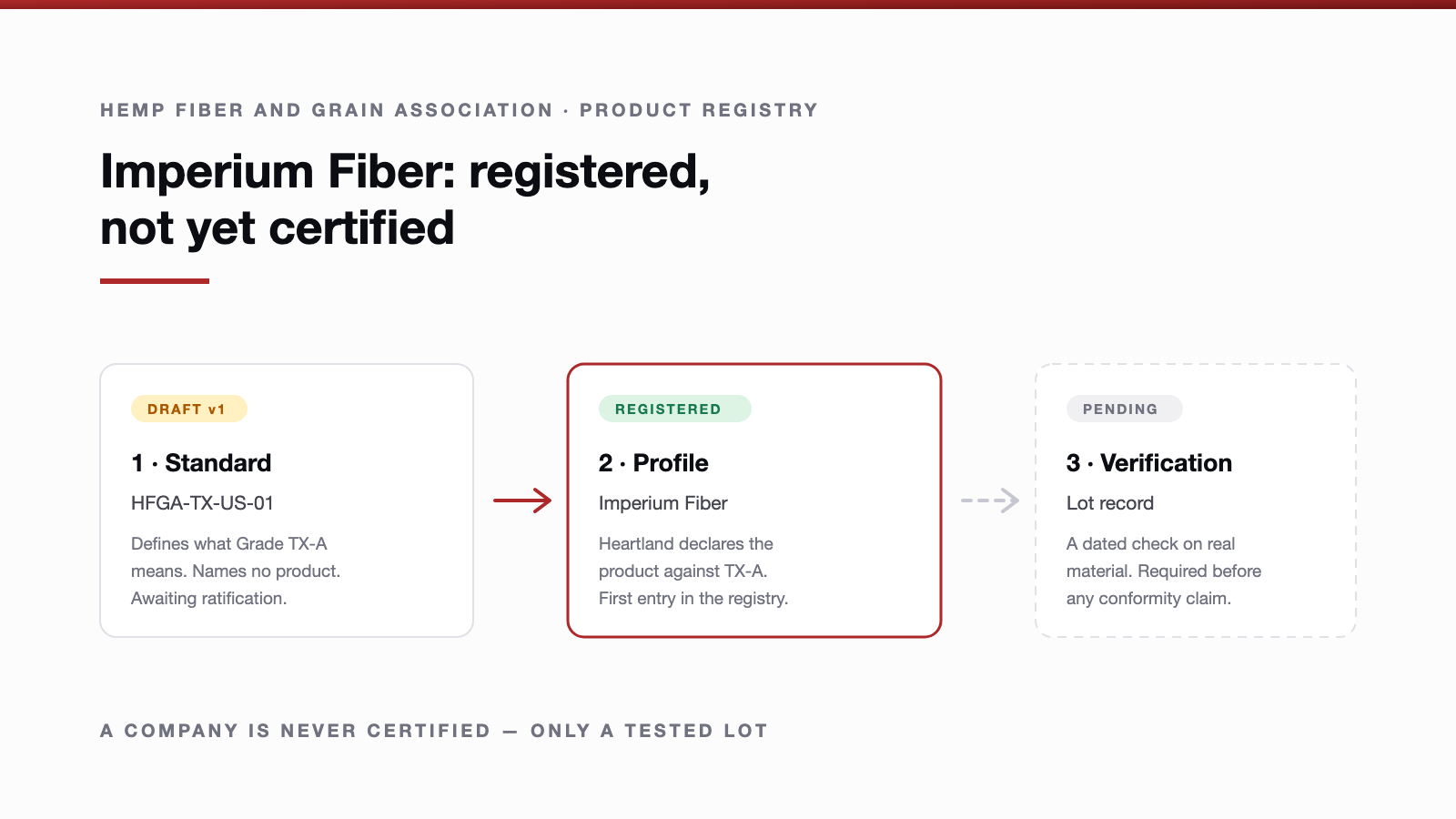
It is a first for the standard, and it is worth being precise about what it is and what it is not. Imperium Fiber is registered, not certified. The registration is a declaration by the manufacturer, published where anyone can read it and check it. No conformity claim attaches to it yet, and none will until two things happen: the standard is ratified, and a specific lot of fiber is tested.
That distinction is not a technicality. It is the whole design. A hemp fiber market that hands out certifications before anyone has tested anything is worth less than no market at all, because the first buyer who checks and finds nothing behind the claim discredits every honest grower alongside the dishonest one.
What Registration Under the US Hemp Textile Standard Actually Means
The HFGA US Hemp Textile Standard is currently published at Draft v1, issued for Technical Committee review with a public comment period. Its own status note is blunt: do not cite it in a purchase contract until it reaches Published status.
Registering a product against a draft is deliberate. It puts the model under load while the text can still be changed. If the profile format is awkward, or a threshold turns out to be unmeasurable in a working mill, the association would rather discover that from a real product than from a hypothetical one.
So the product registry entry for Imperium Fiber carries a pilot marker, and the entry says plainly that it is not a conformity claim. What it does provide is a public, dated, checkable record of exactly what a manufacturer says its industrial hemp fiber is — which is more than most material claims in this industry offer today.
How Imperium Fiber Fits the Hemp Textile Standard's Three-Layer Model
Conformity in the HFGA system is split across three documents that do different jobs. Keeping them separate is what allows a standard to stay stable for years while verification practice adapts within a season.
The US Hemp Textile Standard Defines the Grade, Not the Product
HFGA-TX-US-01 defines what Grade TX-A means: fineness, fiber length, tenacity, residual shive, moisture, restricted substances, and traceability from field to bale. It names no company and no product, and it never will.
This is the neutrality the association's credibility rests on. A standard that names one company's hemp fiber stops being a standard and becomes that company's specification sheet — no competitor can adopt it, and no buyer treats it as independent. Every HFGA standard is written to be adopted by anyone.
The Product Conformance Profile Names Imperium Fiber
The profile is where a named commercial product meets a grade. Heartland declares Imperium Fiber against TX-A, names the varieties and growing regions it draws from, and selects a verification level.
A profile may tighten a threshold below what the standard requires. It may never loosen one. That rule exists so that "TX-A" means the same thing regardless of whose profile cites it — otherwise grade names quietly stop working as a shared vocabulary.
A Lot Verification Record Is Still Required for a Hemp Fiber Claim
The third layer is the one Imperium Fiber has not reached. A Lot Verification Record is a dated check against real material: the evidence bundle examined, results against their limits, and a verdict, issued under the verification scheme rules.
Until an LVR exists, the permitted claim is that the product is registered. It is not that the fiber conforms. A conformity claim cites a lot ID and a date, because conformity is a property of tested material rather than of an organisation.
What This Means for Hemp Fiber and Grain Growers
A registry entry on a textile product might look distant from a field in Michigan. It is not, and the connection runs in a specific direction.
A Working Example From Certified Seed to Finished Hemp Textile
Grade TX-A fiber does not appear at the mill door by accident. It starts with certified seed of a documented variety, certified under the framework maintained by AOSCA, grown under a USDA licence within the Domestic Hemp Production Program, retted and baled to spec, then decorticated without contamination.
Every one of those steps is a grower decision. When a textile product publishes the grade it depends on, growers can see precisely which practices the premium is paying for — instead of guessing what a buyer wants.
Why a Draft Hemp Fiber Standard Still Changes Grower Economics
Buyers discount uncertainty. A processor who cannot describe incoming hemp fiber in measurable terms prices in the risk of being wrong, and that discount comes out of the farmgate price.
A published grade gives both sides something to point at, and acreage and yield reported through USDA-NASS make the comparison to corn and soybean concrete. That is why the association connects growers to vetted buyers before planting and publishes fiber and grain pricing references. Reading the standards and conforming to them is free; only independent verification is charged, and only because it consumes laboratory and assessor time.
Disclosure: HFGA's Affiliation With Heartland Industries
HFGA is affiliated with Heartland Industries, and this first registration is a Heartland product. Stating that plainly is required by the association's own governance, not optional.
Clause 12 of the standard and Clause 8 of the verification scheme require any commercial interest in a profile under consideration to be disclosed on the register, with the interested party taking no part in the decision. A first Lot Verification Record for Imperium Fiber will be issued under those rules or it will not be issued. Growers, mills, and competing processors are invited to read the registry entry, check it against the standard, and comment on the draft — the comment period is open, and every comment receives a written disposition.
FAQ
Quick answers from this article.
Is Imperium Fiber certified to the US Hemp Textile Standard?+
No. It is registered at Grade TX-A. Registration is the manufacturer's public declaration. A conformity claim waits on a lot verification record.
What does the US Hemp Textile Standard name, and what does it refuse to name?+
It defines the grade: fineness, length, tenacity, shive, moisture, restricted substances, and traceability. It names no company and no product.
Can a product profile loosen a TX-A threshold?+
No. A profile may tighten a threshold. It may not loosen one, so TX-A means the same thing no matter whose profile cites it.
What is still missing before Imperium Fiber can claim conformity?+
A Lot Verification Record: a dated check of real material under the verification scheme rules. Until then the permitted claim is that the product is registered.
Does HFGA disclose its link to Heartland on this registration?+
Yes. HFGA is affiliated with Heartland Industries, and the article says that interest has to be disclosed, with the interested party out of the verification decision.