

Why Alfalfa Farmers Should Explore Hemp Fiber Farming in Today's Markets
Why should alfalfa farmers explore hemp fiber farming?+
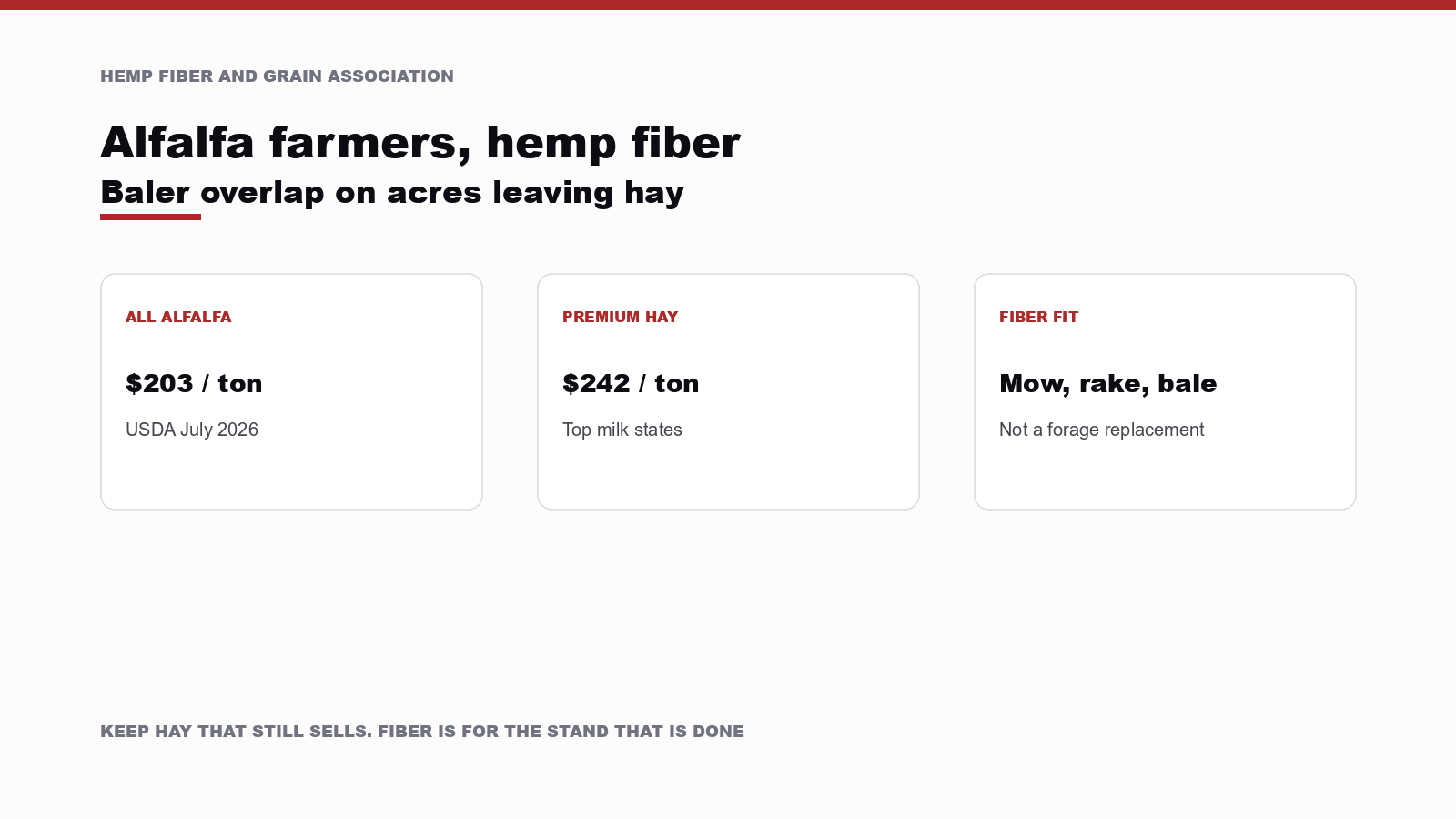
Alfalfa farmers should explore hemp fiber farming on acres already leaving a stand, because the mower, rake, and baler overlap and hay price does not make every old stand worth keeping. It is contracted industrial hemp fiber, not marijuana, and not a forage replacement for the dairy.
Alfalfa farmers should not rip out a stand that is paying for water, cuttings, and the dairy that buys it. Hemp fiber farming is an annual. Alfalfa is a perennial. The exploration is the year a stand is already done, or the field where another cutting no longer covers harvest cost.
USDA Agricultural Prices, published by USDA NASS, put U.S. all alfalfa hay at $203 per ton in July 2026. Premium and supreme alfalfa in the top milk-producing states averaged $242 per ton that month. Quality still gets paid. A thin, weedy, or water-short stand does not become a good stand because the national average moved. Industrial hemp for fiber is not marijuana and not a hay substitute you can feed as alfalfa. It is a licensed crop at or below 0.3% delta-9 THC under USDA AMS. You sell bast and hurd, not a forage test.
Why Alfalfa Farmers Should Trial Hemp Fiber Farming on Exiting Acres
Hemp fiber farming fits the equipment alfalfa farmers already run: mower, rake, baler. It does not fit the ration. Dairies buying your hay are not buying hemp bales, and you should not market them as if they were.
Hay income and hay profit are different. Premium at $242 per ton can carry a strong irrigated stand. The same price will not carry a tired dryland field with a short cutting and a long haul. That is the block to price against a fiber contract. USDA ERS tracks farm income at the sector level. It will not tell you whether your third-year stand should stay. Your cuttings, your water, and a buyer's bale spec will.
Older fiber budgets are regional. Use them as worksheets. The decision on an alfalfa farm is whether the baler should spend a season on contracted fiber instead of on a stand you were going to rotate out anyway. Grain hemp is a weaker equipment match. That case is in hemp grain farming for alfalfa farmers.
What Hemp Fiber Farming Changes When You Leave Alfalfa
You gain a nitrogen credit and a crop you already know how to bale. You lose the forage buyer and the herbicide program you may have used in establishment years.
Soil Test Before Hemp Fiber Farming
A good alfalfa stand leaves nitrogen. Do not apply a full grass-hay rate out of habit, and do not assume the credit covers a fiber crop with no test. The nitrogen guide shows how prior crops change the starting rate for hemp, including the lower start after a legume such as soybean. Alfalfa is the stronger legume. Penn State Extension still cites about 150 pounds of nitrogen for fiber when phosphorus and potassium are optimum. Let the soil test cut that number if the plow-down credit is real. pH near 6.0 to 7.0 and ground that drains are the establishment conditions hemp and alfalfa already share.
Mow and Bale for Hemp Fiber Farming
Fiber is drilled at 35 to 55 pounds per acre, not seeded like a hay mix, and cut from early bloom toward seed set. Then it rests in the field to ret, often for weeks, and is raked before baling. That is not a hay-cutting schedule. Plan the ret so it does not collide with the cuttings you are still making on the stands you kept. Many alfalfa farms do not own a grain drill. Custom drilling is a line item. So is the rule Penn State states plainly: you do not have a labeled herbicide program to clean up a thin stand the way you might in a hay field. Density does that work.
Textile and Construction Buyers
The hemp fiber market outlook splits bast for textiles from hurd for construction. Grades are in the US Hemp Textile Standard. As of 2024 the HFGA network had more than 8,000 tons of fiber on more than 12,000 contracted acres. Commodity pricing is the public reference. Keep twine and wrap out of the bale if the buyer is a mill. A dairy-quality hay wrap habit will ruin a textile lot.
How Alfalfa Farmers Start Hemp Fiber Farming
Rotate out. Do not plow a stand that still has a dairy bid.
Certified Fiber Seed After the License
Get the state license and the 0.3% delta-9 THC obligation straight before you kill the alfalfa. Order certified seed of a fiber variety under AOSCA rules. Timing for a full-season drill is on the spring planting page. This is not an August interseeding into a thin meadow.
Contract Bales Before You Seed
Sell your crop introduces fiber buyers at no charge. Ask for ret method, bale size, moisture, and freight. Your hay broker is the wrong phone call unless that broker has a fiber outlet. Distance to a decorticator matters more than the July hay average.
Keep Paying Hay Acres in Hay
Hemp fiber farming is the annual on acres leaving production, sized so the baler and the crew can still make the cuttings that pay. The FAQ is what you hand a neighbor who thinks the field is cannabis. Trust is a fiber buyer. Education is ret versus a hay cutting. Profit is a contract on ground the stand had already given up.
FAQ
Quick answers from this article.
Should a paying alfalfa stand be torn out for hemp fiber?+
No. Keep a stand that still pays the dairy. Look at hemp fiber on acres already leaving the stand, under a fiber contract.
Which machines overlap between alfalfa and hemp fiber?+
The mower, rake, and baler. Hemp fiber is cut, field-retted, raked, and baled. It is not a forage you feed.
What alfalfa price does the article cite for July 2026?+
USDA Agricultural Prices put all alfalfa at $203 a ton and premium or supreme alfalfa in top milk states at $242 a ton. That does not make every old stand unprofitable.
Is hemp fiber a hay replacement?+
No. It is industrial hemp sold as bast and hurd, not marijuana and not a dairy forage. The buyer is a fiber handler, not the hay broker.
What planting rate fits fiber on a former hay acre?+
Drilled at 35 to 55 pounds per acre, not seeded like a hay mix, on ground near pH 6.0 to 7.0. There is no labeled herbicide program. Density does that work, and many farms need custom drilling.