

Why Alfalfa Farmers Should Explore Hemp Grain Farming in Today's Markets
Why should alfalfa farmers explore hemp grain farming?+
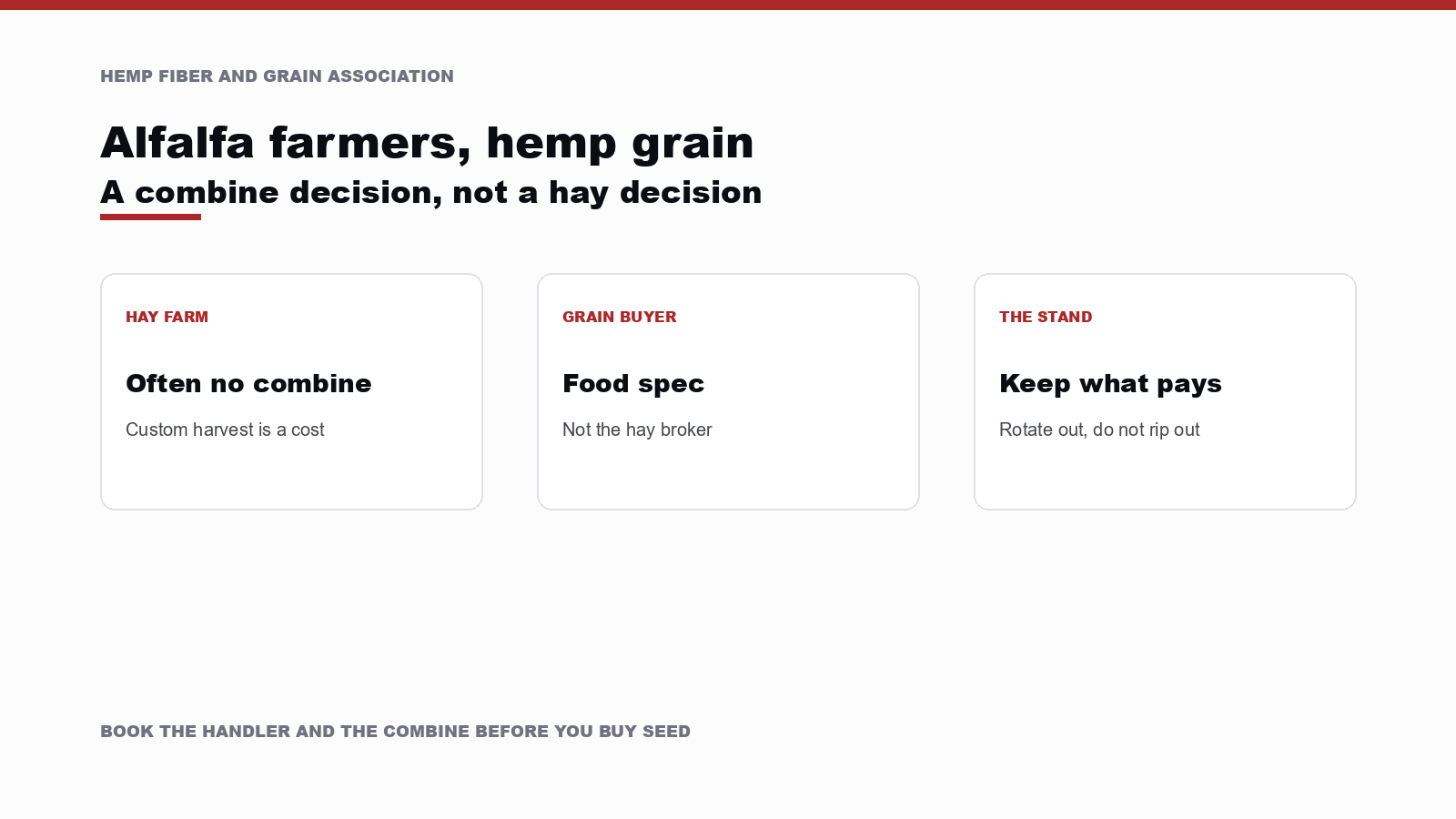
Alfalfa farmers should explore hemp grain farming only on acres leaving a stand, and only if a combine and a food-grain handler are lined up first. Network grain has averaged a 21% premium over soybean. It is industrial hemp, not marijuana, and it does not replace dairy hay.
Alfalfa farmers looking at hemp grain farming are looking at a combine crop. Many hay farms do not own that combine. Custom harvest, drying, and a food handler are the budget, not a footnote. If those three are missing, hemp fiber farming is the closer fit, because it uses the mower and baler you already run.
USDA Agricultural Prices from USDA NASS showed U.S. all alfalfa hay at $203 per ton in July 2026, and premium and supreme hay in the top milk states at $242 per ton. A stand that hits that quality should stay in hay. Hemp grain farming is for the year you are rotating out. Industrial hemp grain is not marijuana, not CBD, and not a forage you can swap into a ration. It is a food and oil seed at or below 0.3% delta-9 THC, licensed under USDA AMS.
Why Alfalfa Farmers Should Price Hemp Grain Farming Against a Handler
The public benchmark for hemp grain farming is soybean, not hay. In the HFGA network, hemp grain has averaged a 21% premium over soybean board pricing, with more than 1,200 tons processed as of 2024. You cannot stack that premium on a per-ton hay price and call it a decision. Different units, different buyers.
Do the acre math in pounds, with the handler's yield and dockage, then compare the net to what the exiting alfalfa stand was actually netting after water and harvest. USDA ERS will not make that comparison for you. The grain association guide explains what the 21% figure is and what it is not. Commodity pricing is the sheet you put beside the bid.
A tired stand and a strong hay market can both be true. Explore hemp grain farming where the stand is done. Leave the dairy hay alone.
What Hemp Grain Farming Requires That Hay Does Not
Alfalfa farmers know establishment, cuttings, and quality tests. Grain hemp asks for a drill rate, a combine, and a moisture target that would be far too wet for baled hay.
Combine Timing for Hemp Grain Farming
Penn State Extension harvests grain hemp at about 70% ripe seed, plants still green, moisture often 22% to 30%. You dry it. You do not wait for a hay-dry windrow. Birds, especially doves, will take seed if you are late. If you do not own a combine, book custom harvest before you buy seed, and confirm the operator has run hemp or will accept green, fibrous material. Wrapping a rotor is a known harvest problem. The derisking guide covers dockage and delivery windows that hay brokers do not use.
Nitrogen Credit and a Grain Seeding Rate
Terminated alfalfa leaves nitrogen. The nitrogen guide starts hemp lower after a legume than after corn. Penn State cites about 150 pounds of nitrogen for a 1,500-pound grain yield when phosphorus and potassium are already optimum. Soil test after you kill the stand, then cut the rate if the credit is there. Grain seeding is typically 25 to 35 pounds per acre, with a drill. Seeding it like alfalfa will not produce a grain crop. White mold history is a reason to pick another field.
Food Handlers for Hemp Grain Farming
Your hay buyer is the wrong customer. Handlers and food brands buy hemp grain. The buyers guide separates processor, handler, and exporter. Straw after the combine can be a fiber lot only if someone contracted it. Otherwise it is residue, not a second hay cutting.
How Alfalfa Farmers Trial Hemp Grain Farming
Three confirmations, in order: the stand is leaving, the handler has a bid, the combine is booked.
Certified Grain Seed and a License
Certified seed of a grain variety, with AOSCA papers, after the state license is in hand. Fiber seed will not make a food spec. The 0.3% delta-9 THC cap is federal. A failed test is a destroyed crop. Spring planting is the window for a full-season grain crop on ground you terminated the previous fall or early spring. Do not interseed it into a living alfalfa stand.
Contract the Food Lot First
Sell your crop introduces handlers at no charge. Write moisture, foreign matter, and freight into the deal. US exports are a possible lane after a domestic spec is met. The 21% premium over soybean goes in the budget only when this buyer is paying it.
Keep the Hay That Still Has a Market
Hemp grain farming on a hay farm is a small block with custom machines, not a new identity for the operation. The FAQ answers what the field is. Trust is a handler and a combine booked before seed. Education is moisture, not a hay test. Profit is a grain check on acres the alfalfa stand was already leaving.
FAQ
Quick answers from this article.
What has to be lined up before hemp grain replaces part of an alfalfa rotation?+
A combine, or a custom harvest you can afford, and a food-grain handler. Hay equipment does not thresh grain.
Does hemp grain replace dairy hay?+
No. It does not feed the herd. Keep the stand that still pays, and only rotate out acres that are already leaving.
What premium is cited for contracted hemp grain?+
About 21 percent over soybean in the HFGA network, and only with a handler booked first. It is not a hay price.
How wet is hemp grain at harvest compared with dry hay?+
Often 22 to 30 percent moisture, cut near 70 percent ripe seed while plants are still green. It needs drying the hay mow does not provide.
Is the July 2026 alfalfa market a reason to exit hay?+
No. All alfalfa was $203 a ton and premium or supreme in top milk states was $242. Price the stand you have before you rip it out.