

Why Corn Farmers Should Explore Hemp Fiber Farming in Today's Markets
Why should corn farmers explore hemp fiber farming?+
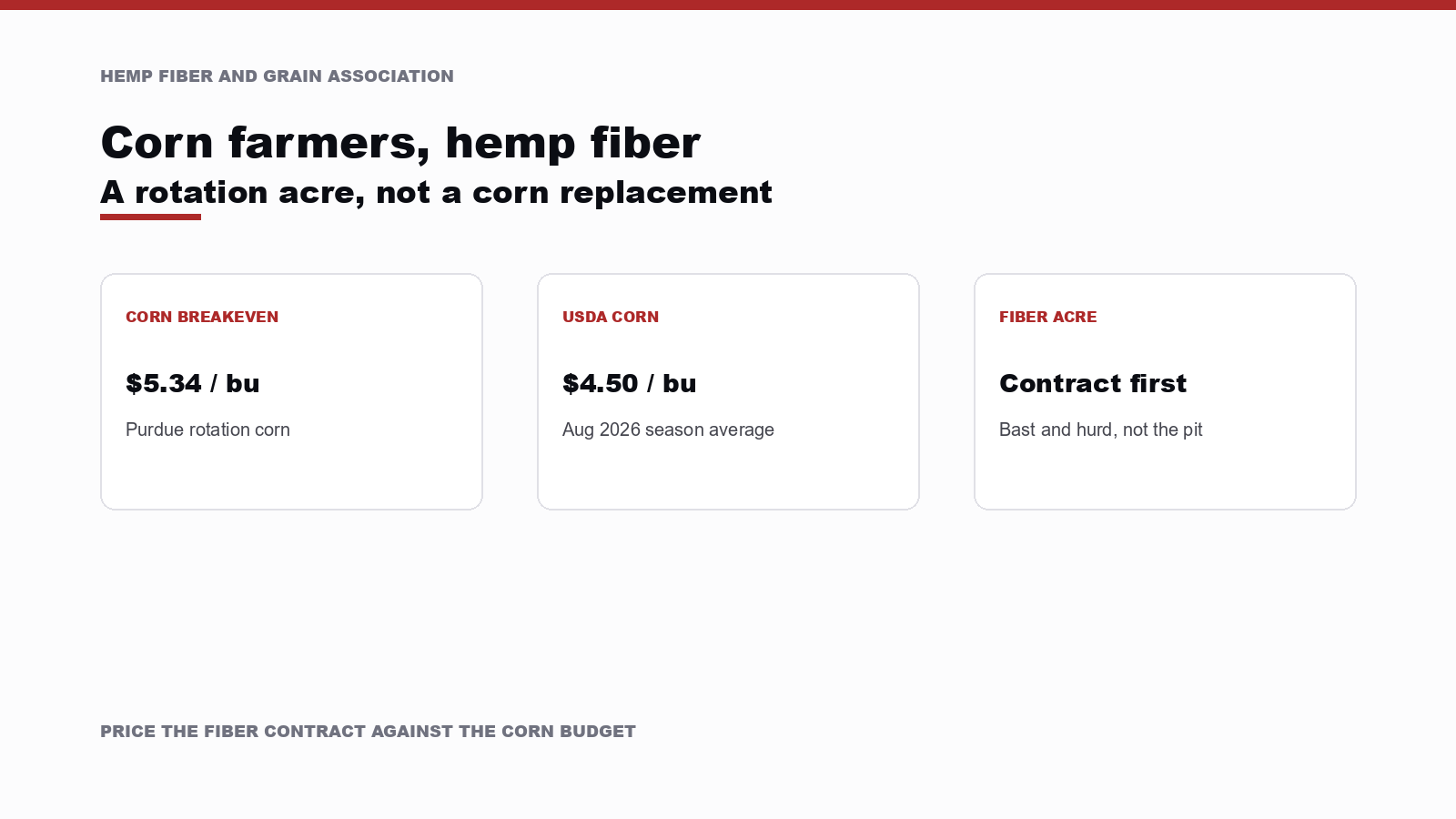
Corn farmers should explore hemp fiber farming because 2026 corn budgets still show total-cost breakevens above USDA's season-average price, while a contracted fiber acre sells bast and hurd to textile and construction buyers instead of the corn elevator. It is a rotation trial of industrial hemp, not marijuana, and not a whole-farm replacement.
Corn farmers know the 2026 arithmetic. USDA's August 2026 WASDE put the season-average corn farm price at $4.50 per bushel. Purdue's January 2026 Crop Cost and Return Guide put rotation-corn breakeven at $5.34 per bushel on average-productivity Indiana soil, with earnings of about -$147 per acre at the $4.35 harvest price used in that budget. Continuous corn in the same table was about -$243 per acre. National corn receipts can still rise on volume, as USDA ERS has forecast, while the acre fails to pay land and labor.
Hemp fiber farming is the rotation question underneath that gap. Industrial hemp grown for fiber is not marijuana and not CBD. It is a non-psychoactive crop under the 2018 Farm Bill, held at or below 0.3% delta-9 THC, licensed through your state department of agriculture under USDA AMS. A fiber acre sells bast and hurd. It does not replace the corn book.
Why Corn Farmers Should Price Hemp Fiber Farming Against Corn
Hemp fiber farming earns a look when the corn acre cannot cover total cost and you already own a drill, a mower, and a baler. It does not earn a look as a slogan that "hemp pays more." Published hemp budgets disagree by state and year. Treat a contract as the number, and treat every university budget as a worksheet.
University of Kentucky estimated a $116 per acre gross return for 175-bushel corn at $4.50 before land rent in its 2026 base case. Subtract a typical western Kentucky cash rent and the rotation can go negative. That is a corn problem. Hemp fiber farming does not fix it by itself. A signed fiber contract on a defined number of acres is a second enterprise with a different buyer.
Older fiber budgets belong in the file, not in the loan narrative. Our corn versus hemp fiber note records a preliminary Michigan budget near +$190 per acre above total costs. Florida's later UF/IFAS dual-purpose budget did not clear full cost. Region and year move the result. Purdue also revised expected grain prices after the January table. Rerun the budget on your rent before you lock a corn-to-fiber story to any one state's earnings line.
What Hemp Fiber Farming Changes on a Corn Farm
Corn farmers switching a few acres into hemp fiber farming change fertility, harvest, and the customer. The planter can stay in the shed. The baler cannot.
Nitrogen After Corn for Hemp Fiber Farming
Corn is a heavy nitrogen user. The association's prior-crop framework, written up in the nitrogen guide, starts near 125 pounds of nitrogen per acre for hemp after corn. Penn State Extension publishes about 150 pounds of nitrogen for fiber when phosphorus and potassium are already optimum, along with 20 pounds of P2O5 and 20 pounds of K2O. Those are different worksheets. A soil test picks the rate. Over-applying because the field "looks yellow after corn" wastes money hemp fiber farming was supposed to save.
Drill and Bale for Hemp Fiber Farming
Penn State recommends drilling fiber at 35 to 55 pounds of live seed per acre, aiming for a stand near fifteen plants per square foot. That density is the weed program. No herbicide list matches what corn farmers are used to. Cut between early bloom and seed set, field-ret the stalks, rake, and bale. Retting can sit in the field for weeks. Plan that window before you promise the processor a date. Grain hemp is a different crop on the same farm; the corn grain comparison covers the combine, not the baler.
Buyers for Bast and Hurd
Textile mills want long bast with low hurd and no synthetic contamination from bale wrap. Construction and composite buyers take shorter fiber and hurd. The hemp fiber market outlook splits those customers. Grades live in the US Hemp Textile Standard. Price references sit on the commodity pricing page. As of 2024 the HFGA network covered more than 12,000 contracted acres and more than 8,000 tons of fiber. Those are network figures, not a national board price.
How Corn Farmers Trial Hemp Fiber Farming This Season
Trial means a contracted block, certified seed, and a harvest plan. It does not mean converting the corn base.
License the Acre, Then Order Seed
Confirm the state license and the 0.3% delta-9 THC rule before you order a bag. Certified seed under AOSCA rules is the compliance document a buyer and a regulator will both ask for. Fiber varieties and grain varieties are not interchangeable. Spring timing for the Corn Belt is on the spring planting page.
Book the Fiber Buyer Before Planting
Sell your crop is a buyer introduction, at no charge, before seed goes in the ground. Ask for the bale spec, the ret method, moisture, and who pays freight. Transportation erases a fiber margin faster than a dime on the corn board. Ethanol demand is a separate, slower pressure on corn acres; the EV and ethanol note is the long view, not this season's contract.
Keep the Corn Base, Add a Fiber Block
Put hemp fiber farming on acres where the corn budget fails after rent, not on your best irrigated corn if that corn still pays. Common questions on smell, legality, and equipment are on the FAQ. The work is trust, education, and profit: a named buyer, a soil test after corn, and a number you can show a lender.
FAQ
Quick answers from this article.
What 2026 corn prices does the article set side by side?+
USDA's August 2026 season-average farm price of $4.50, against Purdue's January 2026 rotation-corn breakeven of $5.34 on average Indiana soil.
Is hemp fiber farming a reason to exit corn?+
No. It is a contracted trial on acres where the corn budget fails after rent, not a whole-farm replacement and not marijuana.
How much nitrogen does the article suggest for hemp after corn?+
About 125 pounds per acre as a start after corn, with a soil test deciding the final rate. Penn State's optimum-P-and-K note is about 150 pounds of N.
What seeding rate does Penn State give for fiber hemp?+
Drill 35 to 55 pounds of live seed per acre, aiming near 15 plants per square foot. That density is the weed program, because there is no labeled herbicide list to match corn.
Is the old plus $190 per acre fiber budget current?+
No. It is a preliminary Michigan figure kept as history. The article says a Florida dual-purpose budget did not clear full cost, so the contract is the number that counts.