

Why Soy Farmers Should Explore Hemp Fiber Farming in Today's Markets
Why should soy farmers explore hemp fiber farming?+
Soy farmers should explore hemp fiber farming because soybean total-cost breakevens have stayed above USDA's season-average price, and a soybean crop leaves nitrogen a fiber acre can use. Hemp fiber farming sells bast and hurd under contract. It is industrial hemp, not marijuana, and it is not a soybean crush substitute.
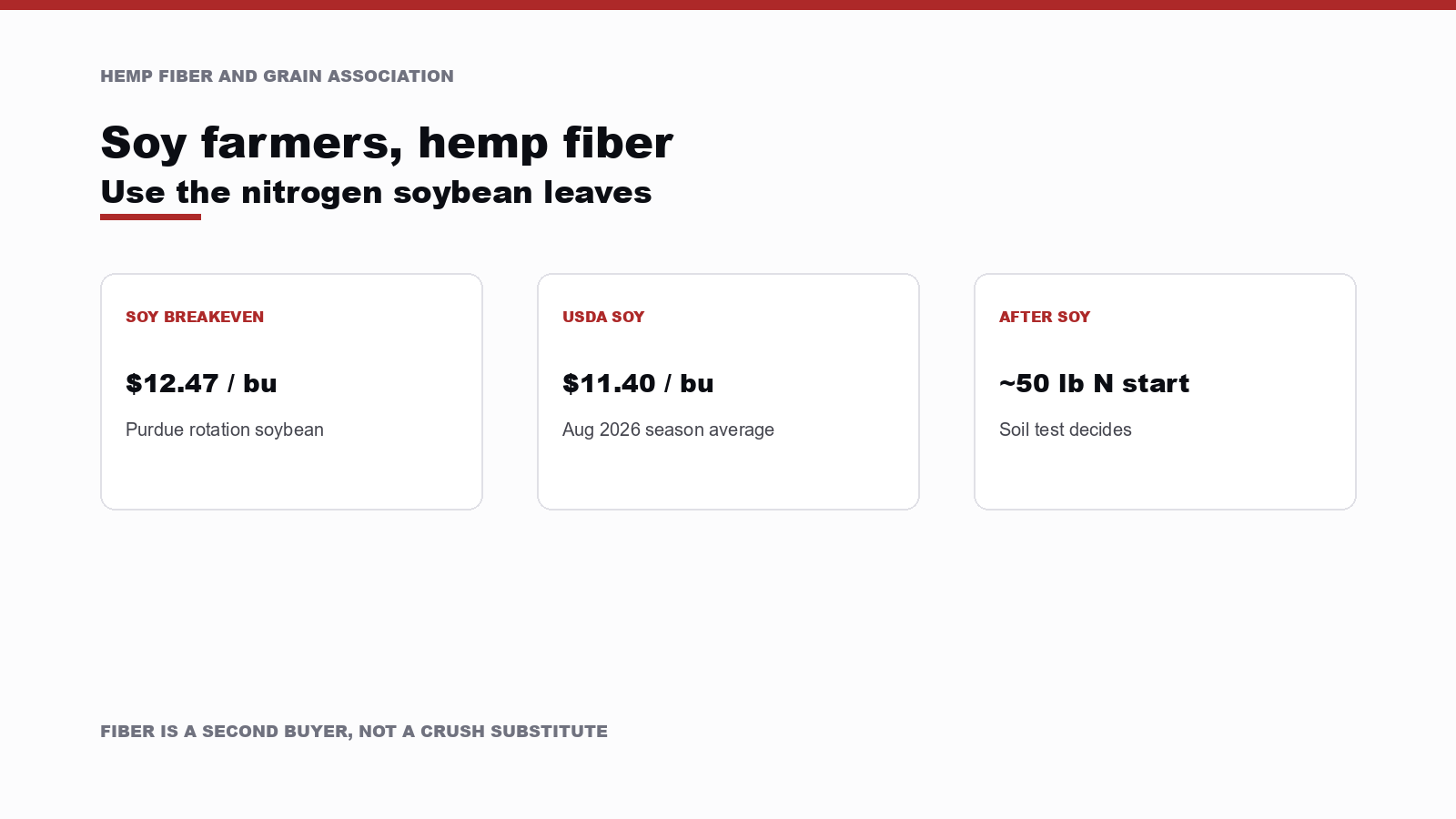
Soy farmers are not in the same hole as continuous corn, and the hemp pitch should not pretend they are. USDA's August 2026 WASDE left the season-average soybean farm price at $11.40 per bushel. Purdue's January 2026 Crop Cost and Return Guide put rotation-soybean breakeven at $12.47 per bushel on average-productivity Indiana soil, with earnings near -$86 per acre at the $10.20 price in that table. University of Kentucky still showed soybean gross returns roughly $100 per acre above corn before rent. Soy is the stronger row crop. Hemp fiber farming has to beat a real soybean acre, not a failing corn acre.
Industrial hemp for fiber is not marijuana and not the CBD market. It is a licensed, non-psychoactive crop at or below 0.3% delta-9 THC under rules published by USDA AMS. You drill it thick, you bale it, and you sell fiber fractions. You do not deliver it to the soybean processor.
Why Soy Farmers Should Trial Hemp Fiber Farming Now
The case for hemp fiber farming on a soy farm is a nitrogen credit plus a second buyer, on acres where rent and machinery overhead eat the soybean margin. It is a poor case on land where $11.40 soybeans still clear your own breakeven.
Purdue revised harvest-price assumptions after January. Use the January earnings as a warning light, then rerun Purdue's guide on your cash rent. USDA ERS expects higher soybean receipts in 2026, mainly from price. Higher receipts and a negative return to land can both be true. Our soybean versus hemp fiber note walks the older Michigan fiber budget. Do not underwrite 2026 on that sheet. A contract will.
Kentucky gross-return tables also show how fast a $200 cash rent erases a 50-50 corn and soybean rotation. If your soy acres are the ones carrying the farm, leave them in soy. Put hemp fiber farming on the block that does not.
What Hemp Fiber Farming Uses After a Soybean Crop
Soy farmers already think in drills, residual nitrogen, and weed programs. Two of those transfer. The herbicide program does not.
A Lower Nitrogen Start for Hemp Fiber Farming
Soybean fixes nitrogen. The association's framework in the nitrogen guide starts near 50 pounds of nitrogen per acre for hemp after soybean, against about 125 pounds after corn. Penn State Extension still publishes about 150 pounds of nitrogen for fiber when phosphorus and potassium are optimum. Reconcile those with a soil test, not with a guess. The profit in hemp fiber farming after soy is partly the fertilizer you do not buy. Spending a corn rate throws that away.
A Dense Drill for Hemp Fiber Farming
Penn State drills fiber at 35 to 55 pounds per acre so the stand, not a post-emerge pass, suppresses weeds. Taller fiber varieties compete harder than short grain types. pH wants to sit near 6.0 to 7.0 on ground that drains. Fields with a white-mold history from soybeans are a bad place to drop a susceptible broadleaf. If you need a combine crop instead of bales, read hemp grain farming for soy farmers.
Fiber Buyers and Grades
Bast for textiles and hurd for construction are different checks. The market outlook and the decorticated fiber standard are the language mills use. As of 2024 the HFGA network had more than 8,000 tons of fiber on contracted acres across 11 states. That is offtake you can ask to see. It is not a promise that every bale finds a mill. Commodity pricing is the public reference while you negotiate.
How Soy Farmers Start Hemp Fiber Farming
Sequence is license, buyer, seed, then the drill. Soy farmers who reverse it repeat the mistake grain growers made in thin hemp markets.
Match Seed to a Fiber Contract
Buy certified seed from a lot that meets AOSCA standards and the buyer's fiber spec. A grain variety drilled thick still will not make textile bast. State licensing sits on top of the federal 0.3% line. Spring planting is the default window unless you are following wheat, which has its own page.
Name the Buyer and the Bale
Use sell your crop to meet processors before you plant. Confirm ret time, bale type, and whether plastic wrap is forbidden. Synthetic contamination ruins a textile bale. Freight to a distant decorticator can cost more than the soybean basis you are used to fighting. US exports matter only after a domestic buyer is real.
Keep Soy on the Acres That Pay
Hemp fiber farming is a trial beside the soybean base, not a referendum on soy. Questions on legality and field appearance are answered on the FAQ. Trust is a buyer who has taken bales. Education is the nitrogen credit after soy. Profit is an acre that clears cost when the soybean breakeven does not.
FAQ
Quick answers from this article.
What soybean breakeven does the article cite for 2026?+
Purdue's January 2026 rotation-soybean breakeven of $12.47 on average Indiana soil, against a USDA season-average of $11.40. The table's own price was $10.20.
How much nitrogen does hemp need after soybean?+
About 50 pounds per acre as a start, because soybean leaves a credit. A soil test still sets the rate. That is less than the roughly 125 pounds suggested after corn.
Is hemp fiber a soybean crush substitute?+
No. The fiber acre sells bast and hurd under contract. It does not replace the soybean you deliver to a crusher.
What does UKY's 2026 note say about soy versus corn gross?+
University of Kentucky still showed soybean gross returns roughly $100 per acre above corn before rent. Hemp fiber has to beat a real soybean acre, not a failing corn acre.
What weed-control limit does a soy farmer inherit with fiber hemp?+
The herbicide program does not transfer. Penn State drills fiber at 35 to 55 pounds per acre so the stand, not a post-emerge pass, suppresses weeds. White-mold history from soybeans is a reason to skip the field.