

Why Soy Farmers Should Explore Hemp Grain Farming in Today's Markets
Why should soy farmers explore hemp grain farming?+
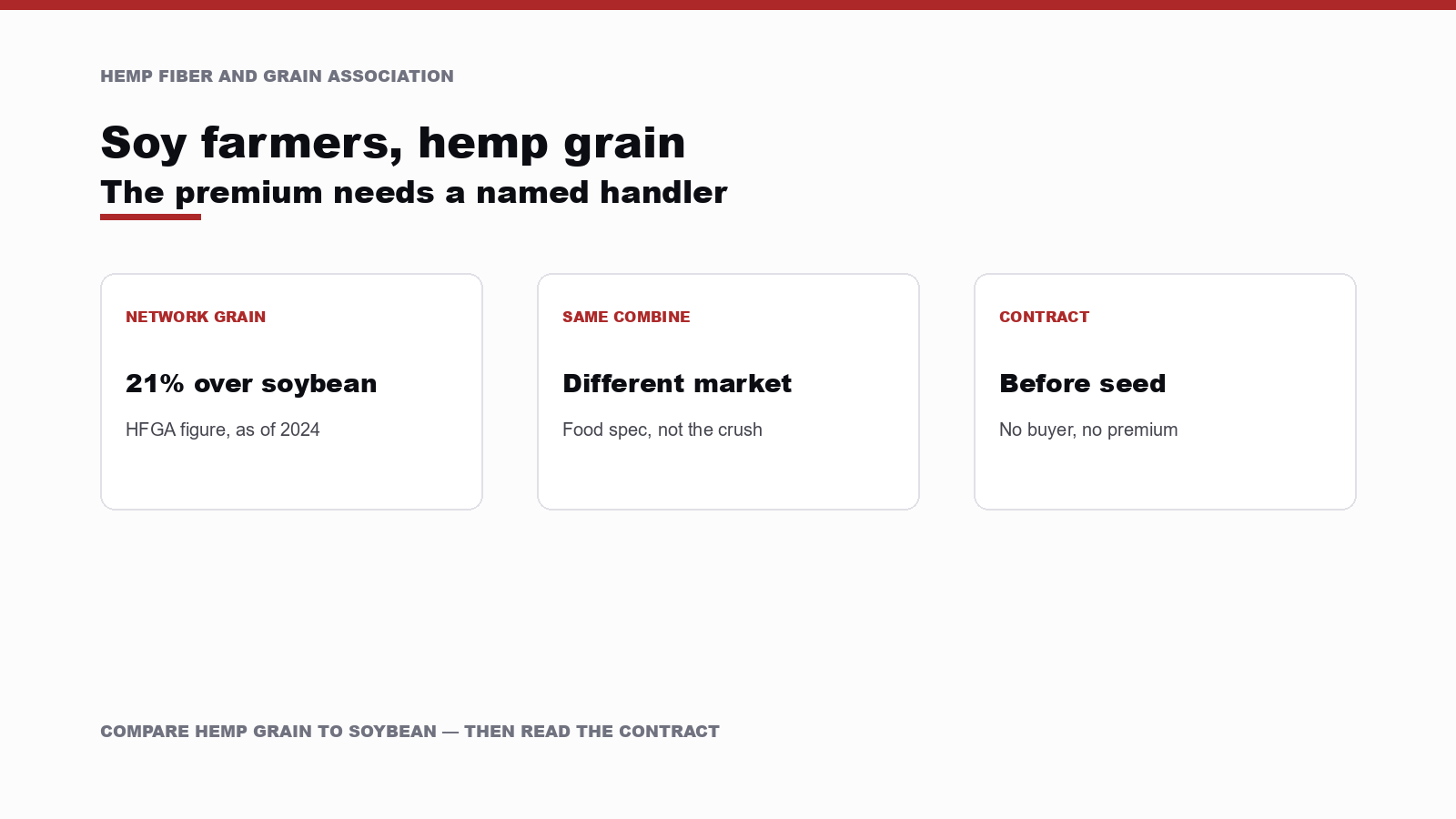
Soy farmers should explore hemp grain farming because association-network grain has averaged a 21% premium over soybean board pricing, while 2026 soybean breakevens still sit above USDA's season-average price. The premium holds only with certified seed and a handler contracted before planting. Hemp grain is industrial hemp, not marijuana.
Soy farmers are the growers hemp grain farming has to convince. The crop is an oilseed. The honest comparison is soybean, not corn. In the HFGA network, hemp grain has averaged a 21% premium over soybean board pricing, on more than 1,200 tons processed as of 2024. That figure is a network observation. It is not a USDA NASS board price, and it does not survive a harvest with no buyer.
USDA's August 2026 WASDE forecast soybeans at $11.40 per bushel. Purdue's January 2026 budget put rotation-soybean breakeven at $12.47 on average Indiana soil. Industrial hemp grain is not marijuana and not CBD flower. It is a food and oil crop at or below 0.3% delta-9 THC, licensed under USDA AMS, planted with a drill, and combined while the plant is still green.
Why Soy Farmers Should Compare Hemp Grain Farming to Soybean
Hemp grain farming is worth a trial where your soybean acre does not clear total cost after rent, and where a handler will pay a premium you can audit. It is not worth ripping out a soybean program that already works.
University of Kentucky estimated about $232 per acre gross return for 55-bushel soybeans at $11.20 before land rent, and warned that a $200 rent turns a corn-soy rotation negative. USDA ERS expects soybean receipts up in 2026 on price. Price recovery and a thin return to management can coexist. Read Purdue's cost guide against your own overhead. The grain association guide shows how the 21% figure should be used: beside a named buyer, not as a slogan.
If the acre you would free is better as bales than as food grain, the companion piece is hemp fiber farming for soy farmers. Dual-purpose sounds efficient and usually needs a choice. Grain-first cuts fiber value. Fiber-first skips the grain check.
What Hemp Grain Farming Shares With a Soybean Operation
The combine, the drill, and the nitrogen credit transfer. The elevator, the herbicide program, and the crush spec do not.
Premium Math for Hemp Grain Farming
A 21% premium over soybean is a price relationship, not a yield relationship. Hemp grain yields are hundreds to about a thousand pounds per acre in published extension budgets, not 60 bushels. Do the acre math with your handler's expected yield, then subtract dockage. Penn State Extension harvests at about 70% ripe seed and 22% to 30% moisture. Dry it. Birds will. The derisking note is the checklist for clean grain and a delivery slot.
Seed Rate and Nitrogen After Soybean
Typical grain seeding is 25 to 35 pounds per acre. After soybean, residual nitrogen is the advantage: the nitrogen guide starts near 50 pounds of applied nitrogen, while Penn State cites about 150 pounds when phosphorus and potassium are already optimum for a 1,500-pound yield goal. Soil test, then split the difference with your agronomist. Avoid fields with white mold history. You do not get a soybean post spray on this crop.
Handlers for Hemp Grain Farming
Soybean has an elevator on every highway. Hemp grain farming has handlers, food brands, and a thinner export lane. The buyers guide names the roles. Commodity pricing is what you compare to the soybean board before you believe a premium. Straw behind the combine can still be sold if the buyer wants it. Ask before you chop it.
How Soy Farmers Put Hemp Grain Farming on a Few Acres
The association rule is the same one soybean growers already respect in a specialty contract: no seed without a home.
Certified Seed for a Grain Program
Order certified seed bred for grain, with AOSCA documentation and a THC history the state will accept. A fiber variety will not hit a food spec just because you combined it. Spring planting fits most soybean regions. Behind wheat is a different calendar and a different disease conversation.
Contract, Then Drill
Sell your crop is the introduction, at no charge. Write down moisture, foreign matter, variety, and freight. US exports are a second door, not a substitute for a domestic handler who has paid before. Without that name, the 21% premium is a story.
Leave Paying Soy Acres in Soy
Trial hemp grain farming where the soybean budget fails, on a block you can dry. The FAQ covers the legality questions neighbors will ask. Trust is the handler. Education is moisture and dockage. Profit is a premium over soybean that still exists after freight.
FAQ
Quick answers from this article.
When does the 21 percent hemp grain premium apply for a soy farmer?+
Only after a named handler is booked, with certified seed. It is a network figure against soybean, not a USDA price and not a reason to drop the soy base.
What Purdue soybean result does the article use?+
Rotation soybean earnings about minus $86 at the table price, with a $12.47 breakeven. Double-crop soybeans in that guide were about plus $135.
How should hemp grain be harvested compared with soybeans?+
Penn State harvests at about 70 percent ripe seed and 22 to 30 percent moisture, then you dry it. It is not a soybean you wait on until the field looks finished.
Does a soybean herbicide program transfer to hemp grain?+
No. The combine, the drill, and the nitrogen credit transfer. The elevator, the herbicide program, and the crush spec do not. Avoid fields with white mold history.
Is hemp grain marijuana?+
No. It is industrial hemp grain at or below 0.3 percent delta-9 THC, a food and oil crop, not a drug crop.