

What GSM Can 24s/1 and 38s/1 Cotton-Hemp Yarn Produce?
What GSM can 24s/1 and 38s/1 cotton-hemp yarn produce?+
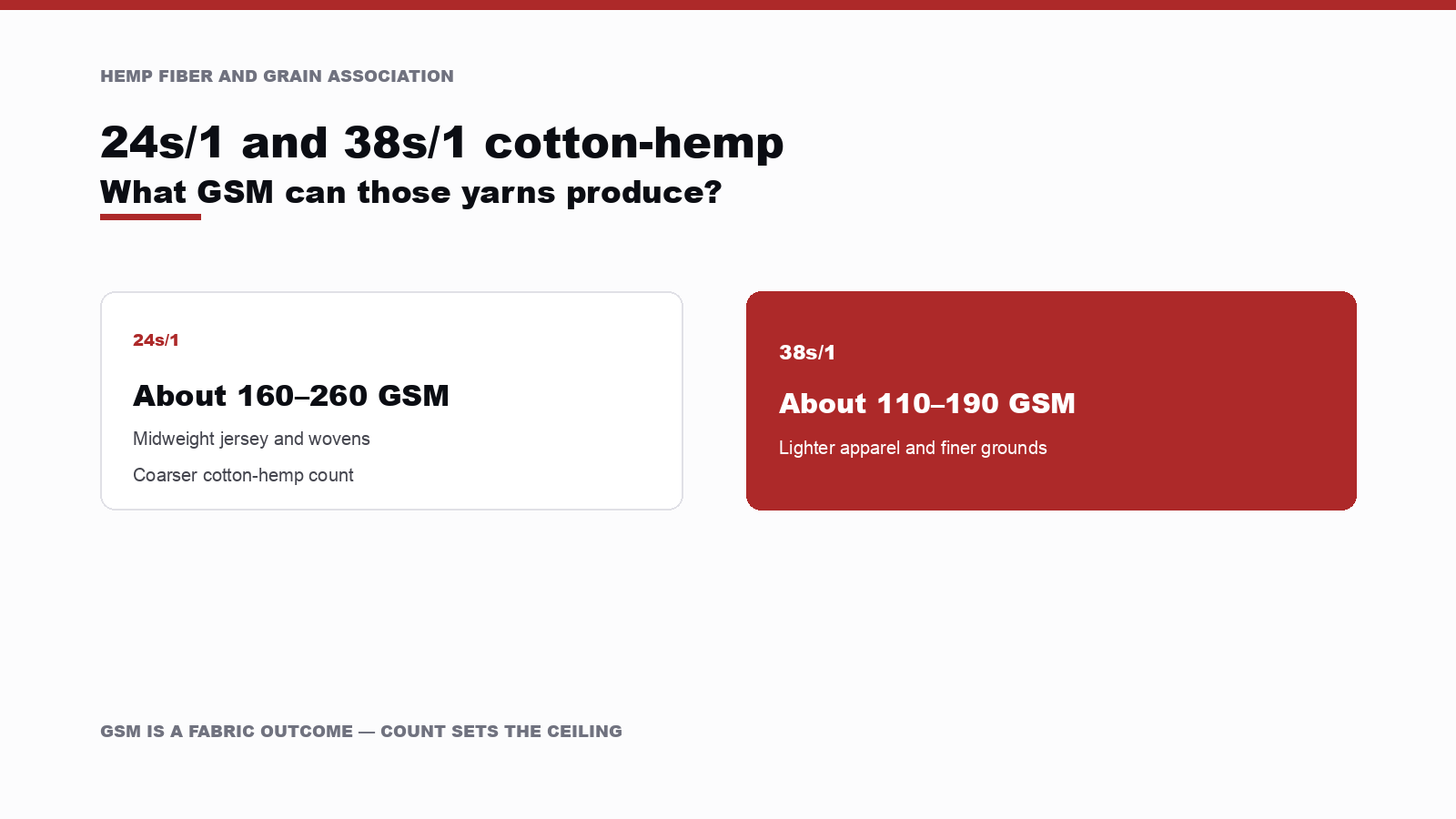
GSM depends on construction. Planning bands: about 160–260 GSM for typical 24s/1 cotton-hemp midweight knits and wovens, and about 110–190 GSM for 38s/1 lighter apparel and finer grounds.
GSM is a fabric number, not a yarn number. Asking what GSM 24s/1 and 38s/1 cotton-hemp yarn can produce is really asking what constructions those counts support once a mill sets stitch density, weave sett, and finishing. In practice, 24s/1 cotton-hemp yarn commonly lands in about 160–260 GSM for typical single-jersey knits and midweight wovens, while 38s/1 more often lands in about 110–190 GSM for lighter apparel knits and finer sheeting constructions — with heavier or lighter outliers when the mill packs or opens the structure.
Those ranges are planning bands for brand and grower conversations, not a lab certificate for every loom. The US-grown hemp behind the yarn still has to grade for the cotton system, which is why this piece sits next to spinning hemp with Supima® cotton and growing hemp for textile yarn.
Industrial hemp in this article means Farm Bill–compliant fiber at or below 0.3% delta-9 THC — not CBD, not marijuana.
How Yarn Count Sets the Ceiling on Cotton-Hemp GSM
English cotton count (Ne) runs opposite to thickness: 38s/1 is finer than 24s/1. Finer yarn can make lighter fabrics at a given construction, or the same GSM with more ends and picks (higher cover). That is why mills pick count before they promise a GSM on a tech pack.
Cotton-hemp yarn at 24s/1 carries more mass per length, so it naturally fills midweight T-shirts, French terry bodies, light twills, and utility sheeting. At 38s/1 the same blend can chase lighter jerseys, finer shirting structures, and the lower-to-mid thread-count bed linen band covered in 120–200 TC cotton-hemp. GSM still moves with gauge, stitch length, and finishing shrinkage — a washed 38s jersey can land heavier than an open 24s construction if the mill designs it that way.
Upstream, finer counts demand cleaner, finer bast. The HFGA US Hemp Textile Standard is the grade language that makes “this lot can feed 38s” a procurement sentence rather than a hope. Production context comes from USDA NASS; licensing from USDA AMS.
Typical GSM Windows for 24s/1 and 38s/1 Cotton-Hemp
Use these as briefing ranges. Always confirm on a bulk trial fabric — not a handloom swatch alone.
24s/1 Cotton-Hemp Yarn — Midweight GSM
Expect roughly 160–260 GSM for common single-jersey and light double-knit apparel, and midweight woven shirting or sheeting when sett is moderate. Brands use 24s/1 cotton-hemp when they want hemp’s hand and durability without going into heavy fleece. Growers should hear “24s program” as a signal for textile-grade fiber with enough length and fineness for cotton-system spinning, not for coarse technical nonwoven lots.
38s/1 Cotton-Hemp Yarn — Lighter GSM
Expect roughly 110–190 GSM for apparel jerseys and finer woven constructions aimed at lighter shirts and bed linen grounds. 38s/1 is where cotton-hemp starts to feel closer to fine cotton programs — including blends discussed with Supima® cotton. It is also less forgiving of residual shive and length scatter; lots that miss TX-A style blend grades usually drop to coarser counts or non-textile grades under the decorticated fiber standard.
Construction Moves GSM More Than Marketing Copy
The same 38s/1 yarn can make a 120 GSM open jersey or a 180 GSM dense jersey. Weave cover factor, knit gauge, heat setting, and enzyme or mechanical finishing all move mass per area. When a tech pack lists both count and GSM, treat GSM as the fabric target and count as the yarn tool — not the other way around. Mill geography and process steps that affect those trials are mapped in the USA → India → USA hemp textile chain.
What 24s and 38s GSM Targets Mean for US Hemp Growers
Count and GSM are downstream specs. The farm decisions that unlock them happen a season earlier.
Finer Counts Need Cleaner Textile Grades
A 38s/1 cotton-hemp program will not be rescued by a milling miracle if the bale is dirty or under-retted. Variety, retting, and wrapper discipline in the textile yarn agronomy guide are the real GSM enablers. Certified seed under AOSCA keeps the variety claim honest for every cone that follows.
Contract Against the Count the Mill Will Spin
If the buyer’s tech pack says 38s/1 at 140 GSM, the acre needs a textile contract, not a spot call in October. Start with sell your crop, check pricing, and read who buys fiber in the US buyers guide. Association context for why grades exist sits in the hemp fiber association guide.
Position GSM Against End Markets You Can Name
Athletic and apparel knits at lighter GSM compete with synthetics — see natural alternative to polyester. Home textiles at mid GSM and 120–200 TC are a different buyer. Matching count → GSM → end use keeps US hemp textile acres from being sold as generic “hemp fabric” into whichever bid arrives first.
24s/1 and 38s/1 cotton-hemp yarn can produce a useful span of GSM — midweight with 24s, lighter and finer with 38s — when construction is intentional and the upstream hemp is graded for the cotton system.
FAQ
Quick answers from this article.
Is GSM a property of the yarn or the fabric?+
GSM is a fabric number. 24s/1 and 38s/1 set the yarn. Stitch density, weave sett, and finishing decide where the cloth lands inside the planning band.
What GSM band is typical for 24s/1 cotton-hemp?+
About 160 to 260 GSM for typical single-jersey knits and midweight wovens. A mill that packs or opens the structure can sit outside that band.
What GSM band is typical for 38s/1 cotton-hemp?+
About 110 to 190 GSM for lighter apparel knits and finer sheeting grounds. The same 38s/1 yarn can make an open 120 GSM jersey or a dense 180 GSM jersey.
Which hemp lots can feed a 38s/1 cotton-hemp program?+
Finer counts need cleaner, finer bast. Lots that miss TX-A style blend grades usually drop to coarser counts or non-textile grades.
Should a tech pack treat yarn count as the GSM?+
No. Treat GSM as the fabric target and count as the yarn tool. Confirm the pair on a bulk trial fabric, not a handloom swatch alone.