

US-Grown Hemp Textile Supply Chain: USA → India → USA
How does the US-grown hemp textile supply chain USA → India → USA work?+
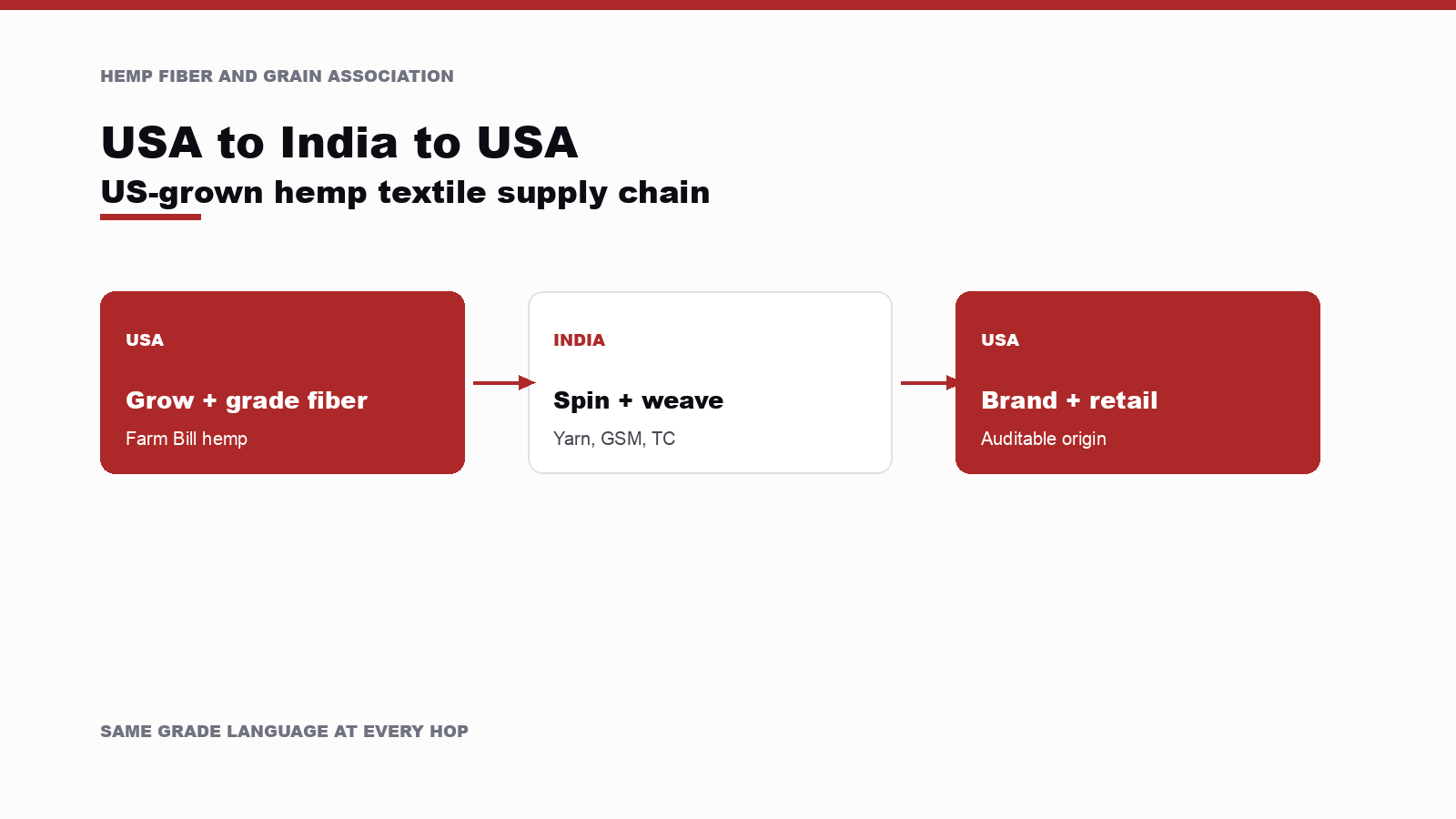
US-grown hemp fiber is graded in the USA, often spun and woven in India, then returned as yarn or finished goods for US brands — a pattern that uses American fiber and standards with Indian mill capacity.
The dominant near-term path for many US-grown hemp textile programs is USA → India → USA: fiber (or refined stock) grown and often partially processed in the United States, spun and/or woven in India, then returned as yarn, fabric, or finished goods for American brands. That route exists because India still holds deep cotton-system spinning and sheeting capacity, while US acres can supply Farm Bill–compliant industrial hemp — non-psychoactive fiber at or below 0.3% delta-9 THC — under documented grades.
This is not a claim that every bale must leave the country. Domestic US spinning is growing. It is a description of a real commercial pattern brands already run for cotton, and increasingly for cotton-hemp and hemp blends — including programs that ask whether US hemp spins with Supima® cotton, what GSM 24s/1 and 38s/1 can hit, and whether 120–200 TC bed linen is feasible.
Why the USA → India → USA Hemp Textile Route Exists
US farms can grow textile hemp. US brands can sell sheets and apparel. The missing middle for many SKUs is still large-scale fine spinning and sheeting infrastructure at cotton-program cost. India’s mills already run those frames for cotton; refined US hemp that meets cotton-system specs can ride the same equipment — which is the practical meaning of TX-A style grades in the HFGA US Hemp Textile Standard.
A USA → India → USA chain therefore optimizes for where each step is strongest today: American acres and standards upstream, Indian spinning/weaving midstream, American brand, compliance, and retail downstream. Trade exposure, tariffs, and documentation still matter — see how tariffs hit US hemp fiber and grain and the association’s US exports work. USDA FAS publishes the trade data worth watching before locking a season’s offtake to an export-linked mill program.
Industrial hemp in this chain remains distinct from marijuana. Every export packet that forgets that distinction creates customs and retailer risk.
What Moves at Each Hop of the USA → India → USA Chain
Clarity about what crosses the border prevents grade fraud and QC fights.
USA Leg — Grow, Rette, Decorticate, Grade
The farm and first processor create the only asset the rest of the chain cannot fake: documented US-origin bast. Certified seed, retting, and wrapper discipline from the textile yarn agronomy guide decide whether India receives cottonizable fiber or a problem lot. Grade against HFGA textile and decorticated fiber language before container stuff. Licensing: USDA AMS. Production context: USDA NASS.
India Leg — Spin, Weave, Finish
Indian mills convert graded fiber or tops into yarn counts (including cotton-hemp 24s/1 and 38s/1), fabrics at target GSM, and sheeting constructions in the 120–200 TC band. This is where blend bills with cotton — sometimes premium US cotton — are executed. QC failures here are usually upstream grade failures arriving late. Brands should require lot IDs that trace to US fibre documentation, not only a mill invoice.
USA Leg — Import Yarn or Goods, Brand, Sell
Finished cones, greige, or cut-and-sew goods return for brand distribution. Claims such as “US-grown hemp” must still be true of the fiber origin, even when spinning happened abroad. That is why association standards and registry models like Imperium Fiber’s registration matter: they attach identity to material, not to a marketing mood.
How Growers and Brands Keep a USA–India–USA Chain Honest
A long chain fails in paperwork before it fails in yarn strength.
Contract Fiber to the Mill Spec, Not to a Vague “Export”
If the India mill will spin 38s/1 cotton-hemp for 150 GSM jersey or 180 TC percale, write that into the US fiber contract. Use sell your crop, pricing references, and buyer types. Spot straw cannot schedule ocean freight and loom time.
Treat Traceability as a Product Feature
Seed lot, grower licence, lot verification, and bill of lading should travel with the fiber. What Is HFGA and the hemp fiber association guide exist so US origin claims survive an audit after goods return from India. AOSCA seed frameworks and AMS rules are the statutory floor; HFGA grades are the textile vocabulary on top.
Plan End Uses Before the Container Sails
Athletic knits (polyester alternative), cotton-hemp apparel, and bed linen pull different grades and counts. A USA → India → USA program that ships “whatever fiber we have” will be spun into whatever is convenient — and sold at a discount. Name the SKU family first, then book the acres.
US-grown hemp textiles do not require leaving the country — but when they do, USA → India → USA is a coherent pattern: American fiber and standards, Indian mill capacity, American brand. Keep each hop documented, and the chain holds.
FAQ
Quick answers from this article.
Must every US hemp textile bale be spun in India?+
No. The article says US-grown hemp textiles do not have to leave the country. USA to India to USA is the pattern when Indian mill capacity is the missing middle.
Why do US hemp textile programs use Indian mills?+
India still holds deep cotton-system spinning and sheeting capacity. Refined US hemp that meets cotton-system specs can ride frames those mills already run for cotton.
What does the US leg of a hemp textile chain have to create?+
Documented US-origin bast: certified seed, retting, wrapper discipline, and a grade before the container is stuffed. The rest of the chain cannot fake that origin.
Does spinning in India erase a US-grown hemp claim?+
No, if the fiber origin is still true. US-grown hemp can be spun abroad and return as yarn or goods, as long as the claim is about the fiber, not the mill's country.
What fails first in a long hemp textile chain?+
Paperwork. Seed lot, grower licence, lot identity, and the bill of lading have to travel with the fiber. A vague export of whatever straw is on hand gets discounted.