

Can US-Grown Hemp Be Spun with Supima® Cotton?
Can US-grown hemp be spun with Supima® cotton?+
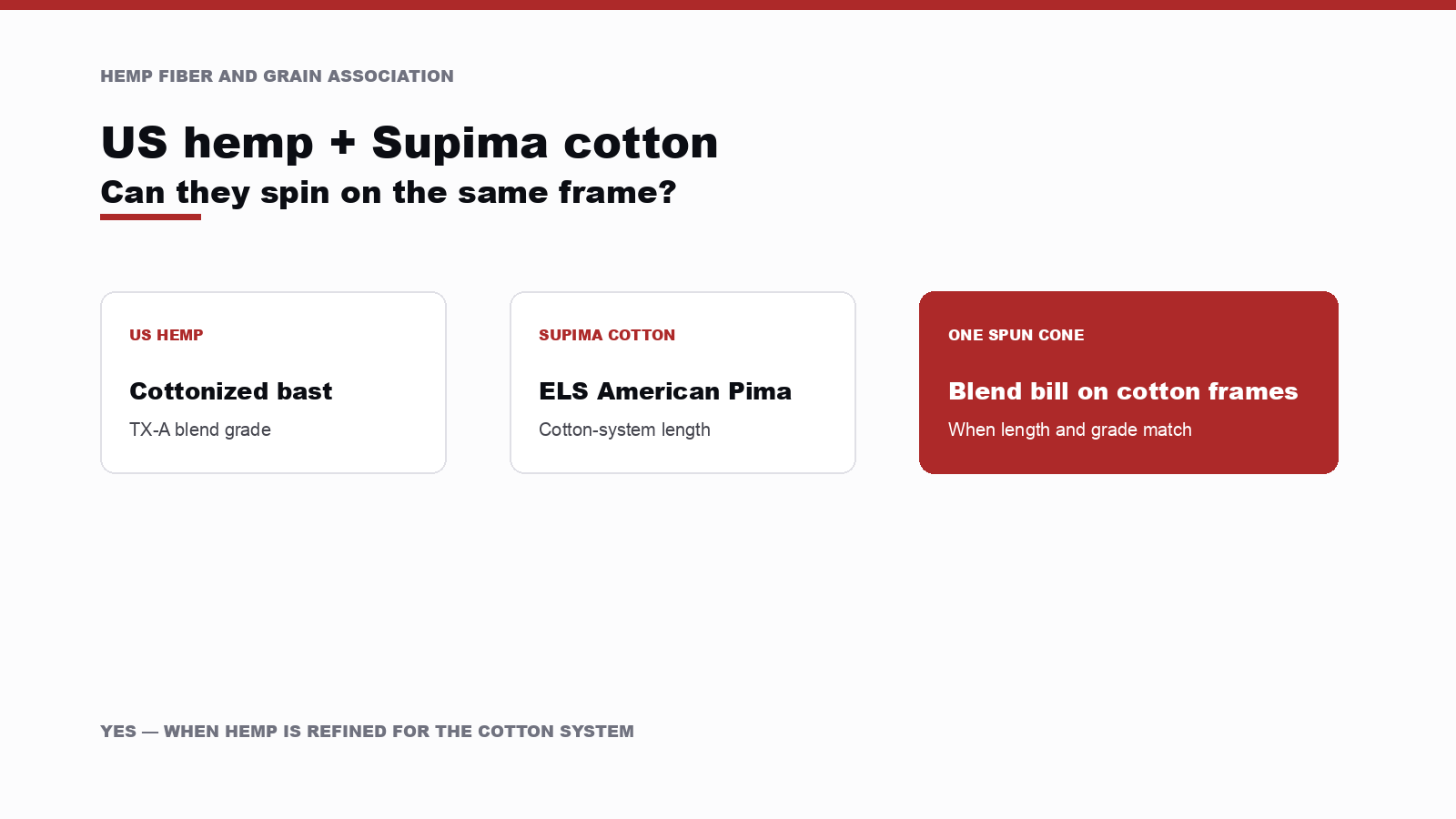
Yes — when US-grown hemp is refined for the cotton system (cleaned, cottonized, and graded), it can blend and spin with Supima® cotton on cotton-system frames. Supima® is a third-party trademark; HFGA claims no affiliation.
Yes. US-grown industrial hemp can be spun with Supima® cotton when the hemp is prepared for the cotton spinning system — cleaned, refined (often called cottonized), and graded so its length and fineness sit in a window a cotton-system mill already understands. Supima® is a registered trademark for American Pima (extra-long staple) cotton; this article does not claim any affiliation with Supima. It answers the blending question from the hemp fiber and grain association side: what the acre and the standard must deliver so a mill can put both fibers on the same frame.
Industrial hemp here means fiber grown under the 2018 Farm Bill at or below 0.3% delta-9 THC. It is not CBD and not marijuana. The crop that makes a cotton-hemp blend possible starts with certified seed, field discipline covered in growing hemp for textile yarn, and a published grade under the HFGA US Hemp Textile Standard.
Why US-Grown Hemp Spins with Supima® Cotton on the Cotton System
Cotton-system spinning (including frames that run fine ELS cotton such as Supima®) expects fibers in a relatively narrow length and fineness band. Raw bast hemp straight from the stalk does not. What does work is refined bast that has been opened into cotton-like staple — the same TX-A / blend-and-cottonize lane the textile standard describes for cotton-system spinning.
That is the technical answer behind “can US-grown hemp be spun with Supima® cotton?” The brand question and the farm question are different. Brands want hand, strength, and a story that survives a wash test. Farms want a grade and a contract. A hemp fiber association exists to keep those two vocabularies aligned so a mill can write a blend bill without inventing one.
Licensing sits under the USDA AMS Domestic Hemp Production Program. Acreage data lands in USDA NASS. Seed certification follows AOSCA. None of those agencies spin yarn — but without them, a cotton-hemp claim has no upstream paperwork a brand can audit.
What Has to Be True for a Hemp–Supima® Blend to Run
Three conditions, all measurable, before anyone promises a cone.
Grade and Fineness for Cotton-System Hemp
TX-A and related blend grades exist so a spinner can treat US hemp like a known input. Residual shive, foreign matter, moisture, and fineness determine whether the fiber opens cleanly with cotton or clumps and breaks. Read the US Hemp Textile Standard and the upstream decorticated fiber standard before promising a Supima®-class blend. Marketing that skips grade language is how lots fail at the first mill trial.
Length Compatibility with Extra-Long Staple Cotton
Supima® cotton is valued for staple length and strength. Hemp that is still in long-line form belongs on a different spinning route. Cottonized or sufficiently opened hemp is what meets a cotton-system blend. That refining step is usually off-farm — which is why US-grown hemp textile supply chains often move fiber through specialized processors before yarn. The farm’s job is to deliver clean, documented, textile-eligible bast so that step has something worth refining.
Clean Handling So the Blend Stays Microplastic-Free
Synthetic bale wrap through a decorticator contaminates fiber permanently. A cotton-hemp yarn sold as plant-based loses that claim the moment plastic shreds enter the stream. Wrapper discipline and moisture limits are covered in the yarn agronomy guide; they matter more for premium cotton blends than for coarse technical grades. Brands pairing hemp with Supima® cotton are buying purity as much as performance — the same purity brief behind natural alternatives to polyester.
How Growers and Brands Make the Hemp–Supima® Answer Bankable
Technical feasibility is not a purchase order. The commercial path still runs seed → grade → buyer → mill.
Contract Textile Acres Before Promising a Blend
Mills plan blend programs a season ahead. Spot hemp cannot support a Supima®-positioned SKU. Contract through sell your crop introductions, price against commodity references, and treat textile offtake like any other specialty crop. Imperium Fiber’s registry path shows how a named commercial fiber maps to a published grade — the model a cotton-hemp program should copy.
Match Yarn Count to End Use, Not Hype
Once hemp and cotton share a cone, count and construction set GSM and hand. See what 24s/1 and 38s/1 cotton-hemp yarn can produce, and whether those yarns reach 120–200 TC bed linen. Supima® blends often sit at the fine end of that menu; coarser hemp-cotton mixes serve knits and midweight wovens instead.
Use Association Vocabulary From Acre to Label
What Is HFGA and the hemp fiber association grower guide exist so “US-grown hemp spun with Supima® cotton” is a checkable claim, not a mood. Export and processing geography — including India spinning capacity — belongs in the USA → India → USA supply chain brief and US exports.
Yes, US-grown hemp can be spun with Supima® cotton. The acre that makes that true is graded, contracted, and clean — and the association’s job is to keep that bar visible to every party in the blend.
FAQ
Quick answers from this article.
Does HFGA claim an affiliation with Supima?+
No. Supima is a registered trademark for American Pima extra-long staple cotton. This article answers the blending question and claims no affiliation with Supima.
What has to happen to hemp before it shares a frame with Supima cotton?+
The bast has to be cleaned, refined into cotton-like staple, often called cottonized, and graded so length and fineness sit in a window a cotton-system mill already runs.
Can long-line hemp go on the same spinning route as Supima cotton?+
No. Long-line hemp belongs on a different route. Cottonized or sufficiently opened hemp is what meets a cotton-system blend.
What ruins a plant-based claim in a hemp and Supima blend?+
Synthetic bale wrap through a decorticator shreds into the fiber and cannot be separated. That contamination ends a microplastic-free claim.
Is a successful mill trial the same as a purchase order?+
No. Mills plan blend programs a season ahead. Spot hemp cannot support a Supima-positioned SKU. The acre still needs a grade and a contract.