

Growing Hemp for Textile Yarn: What a Mill Program Asks of a US Farm
What does growing hemp for textile yarn require from a US farm?+
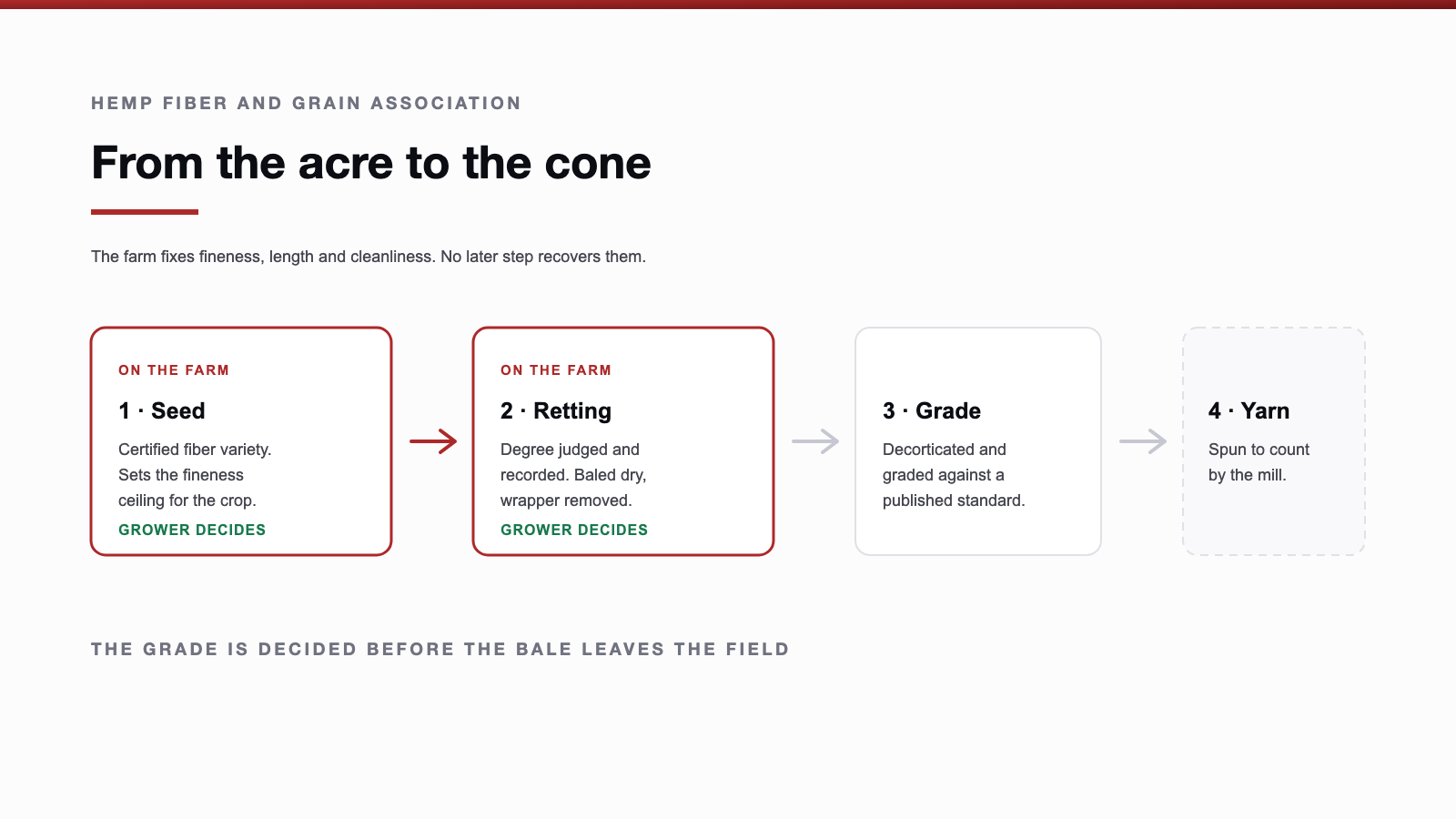
Growing hemp for textile yarn requires certified seed of a fiber variety, controlled retting, moisture and wrapper discipline, and a grade that meets the HFGA US Hemp Textile Standard so a mill can spin the lot.
A mill ordering fine-count hemp yarn is buying the last step of a chain that starts eighteen months earlier, on an acre in the Midwest. The yarn spec is written downstream — count, blend, twist — but almost every property it depends on was fixed in a field, by decisions a grower made before the drill went in.
This article is about that upstream half. If you want the downstream specification itself, Heartland publishes it: their 40/2 and 40/1 hemp/lyocell yarn specification covers counts, blend, twist, and how the yarn runs on existing knit frames. What follows is what a US farm has to deliver so that a cone like that can exist at all.
Industrial hemp here means fiber varieties grown under the 2018 Farm Bill at or below 0.3% delta-9 THC. Non-psychoactive, federally compliant, planted with a grain drill. Nothing to do with CBD or marijuana.
What Growing Hemp for Textile Yarn Actually Requires
Textile yarn is the most demanding destination a hemp acre can have. Insulation and composite buyers tolerate coarse fiber, high hurd content, and variable colour. A spinner does not — fineness, length consistency, and cleanliness determine whether fiber runs on a frame or breaks on it.
That is why growing hemp for textile yarn is a different proposition from growing hemp for tonnage. The agronomy is not harder, but it is less forgiving, and the payoff sits in the grade rather than the yield. A heavier crop that grades out of textile use is worth less than a lighter one that makes the spec.
The vocabulary for that grade is published and free to use. The HFGA US Hemp Textile Standard defines what a textile grade means, and the decorticated fiber standard grades the bale before refining. Growers who read those before harvest make different handling decisions than growers who read them after.
The Three Field Decisions a Yarn Program Depends On
Three choices, all made on the farm, set the ceiling on what any downstream mill can do with the crop.
Variety Choice Sets the Ceiling for Textile Yarn
Fiber varieties and grain varieties are not interchangeable, and dual-purpose crops sit between them. A variety bred for stalk yield produces different fineness than one selected for fiber quality, and no amount of processing recovers what the genetics did not provide.
Certified seed of a documented variety is the precondition for every downstream claim, certified under the framework maintained by AOSCA. The association introduces growers to vetted seed suppliers at no cost, and the seed lot number follows the crop through every record afterwards.
Retting Determines Whether Fiber Spins
Retting is the biological step that lets bast fiber separate cleanly from the stalk, and it is where most textile-grade crops are won or lost. Under-retted straw holds fiber bundles too tightly for fine spinning. Over-retted straw loses tenacity.
Field retting remains standard US practice and is fully eligible for every grade. What matters is that the retting degree is judged and recorded rather than assumed, because a mill blending across lots needs to predict batch-to-batch behaviour.
Moisture and Wrapper Discipline Protect the Whole Lot
Two handling habits protect more textile value than any agronomic adjustment. Bale at or below 15% moisture and store under cover, off the ground. And remove every scrap of bale wrap, netting, and twine before the stalk reaches a decorticator.
That second one is absolute. Synthetic wrap fed through a decorticator shreds into the fiber and cannot be separated afterwards — it disqualifies the lot for textile use permanently and defeats any microplastic-free claim a brand makes downstream. EPA tracks why that claim matters to the people buying the finished garment.
The Grower Economics of Growing Hemp for Textile Yarn
Meeting a textile spec only makes sense if the acre pays.
Contract Acres Beat Spot Sales
Textile programs plan volume a season ahead, which means they contract. A contract before planting converts a speculative acre into a known one and gives the grower a price to compare against corn and soybean. The association's network runs on contracted acres — 12,000+ across 11 states as of 2024, with 8,000+ tons of fiber processed.
Grade Determines Which Yarn Count a Lot Can Feed
Finer yarn counts need finer fiber. A lot that grades into the cotton-system blend lane feeds a different product than one that grades to long line, and both are legitimate outcomes with different buyers. Knowing which lane a field is headed for, before harvest, is what lets a grower price it honestly. The product registry shows how a named commercial fiber maps to a published grade.
Where the Farm Sits in the Cone-to-Acre Chain
Fiber leaves the farm, is decorticated and refined, then spun. Each step is a separate business with its own margin, and growers who understand the whole chain negotiate better than growers who see only the first sale. Start with the hemp fiber market and who the buyers are, then check current pricing references. Downstream specs that pull those acres — cotton-hemp with Supima®, 24s/1 and 38s/1 GSM, 120–200 TC bed linen, and the USA → India → USA textile chain — are how mills turn a graded bale into a purchase order.
Production data by state comes from USDA NASS, and licensing from USDA AMS. When the numbers work, the introduction to a buyer is free: start at sell your crop.
FAQ
Quick answers from this article.
Are fiber and grain hemp varieties interchangeable for textile yarn?+
No. Fiber varieties and grain varieties are not interchangeable. A variety bred for stalk yield will not gain fineness in processing that the genetics did not provide.
What moisture and wrap rules protect a textile hemp lot?+
Bale at or below 15% moisture and store under cover, off the ground. Remove every scrap of bale wrap, netting, and twine before the stalk reaches a decorticator.
Why does synthetic wrap disqualify textile hemp?+
Synthetic wrap fed through a decorticator shreds into the fiber and cannot be separated afterwards. That permanently disqualifies the lot for textile use.
How large was the HFGA contracted network in 2024?+
The association's network ran on contracted acres: 12,000-plus across 11 states as of 2024, with 8,000-plus tons of fiber processed.
Is a heavier hemp crop always worth more for yarn?+
No. Textile yarn pays on grade, not tonnage. A heavier crop that grades out of textile use is worth less than a lighter one that makes the spec.