

US-Grown Hemp in India, with Heartland Promoting It
How is Heartland promoting US-grown hemp in India?+
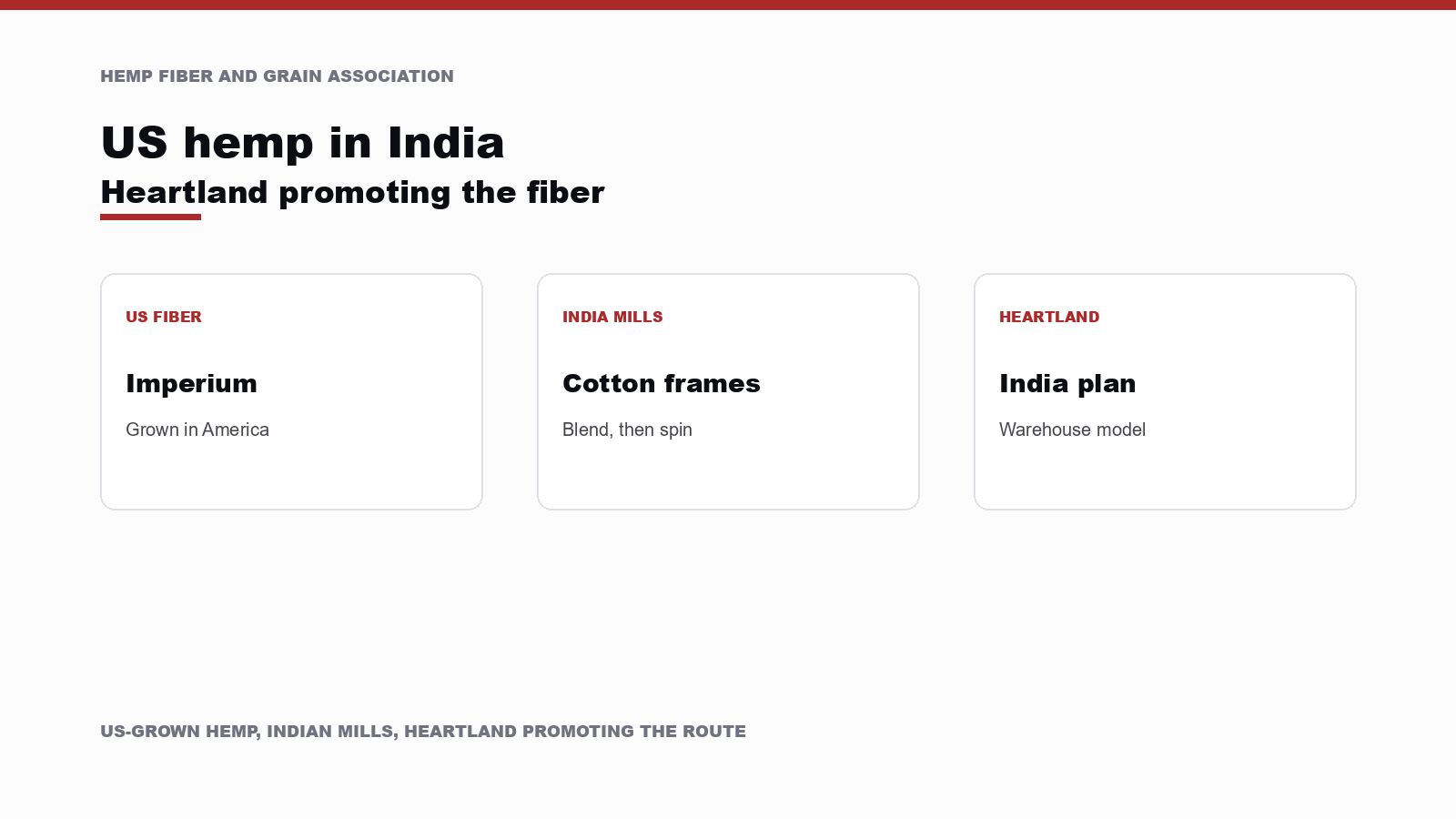
Heartland is promoting US-grown hemp in India as fiber Indian mills can blend and spin on cotton systems, including Imperium with Supima. The Textile Magazine interview is the source. HFGA is affiliated with Heartland. Imperium is registered at Grade TX-A, not certified.
The Textile Magazine published an interview on 6 October 2026 with Amey Padma, Head of India Business at Heartland, on US-grown hemp in India. Heartland is promoting US-grown Imperium fiber as a material Indian mills can blend and spin, including with Supima cotton, on the frames they already run.
HFGA is affiliated with Heartland Industries. The magazine's byline says Heartland USA. That commercial interest is named here on purpose, the same way the registry requires a commercial interest to be disclosed. This page reports the interview. It does not audit a warehouse, and it does not turn a registration into a certificate.
The fiber in the story is industrial hemp under the 2018 Farm Bill, at or below 0.3% delta-9 THC, licensed through USDA's Domestic Hemp Production Program. It is not marijuana and it is not CBD. AOSCA is the seed framework a textile lot still has to clear. The grade a mill can cite is TX-A on the US Hemp Textile Standard.
Why US-Grown Hemp in India Is a Mill Question
Padma's line in the interview is the one to keep: sustainability gets attention; performance and economics drive adoption. He describes the hemp market moving from niche toward industrial use through blends with cotton, lyocell, and other fibers. Mainstream use, in his account, waits on three things: consistency, economics, and supply that shows up again next season.
That is a mill question before it is a brand question. A spinner needs consistent fineness, length, strength, cleanliness, and spinnability. A fiber that forces a different machine room stays a sample. Heartland's stated aim is the other path: US-grown hemp in India that runs on existing spinning machinery.
India is the platform in the interview because the mills already blend fibers across spinning, weaving, knitting, processing, and garments. Padma says that blending skill makes India a development platform for hemp-cotton, hemp-cellulosic, and other engineered blends. HFGA's note on the USA to India to USA chain describes the same geography from the fiber's side. This article adds the company promoting the fiber into that geography. Trade exposure on the route is in how tariffs hit US hemp fiber and grain. USDA FAS publishes the trade data worth reading before a season is locked to an export mill.
What Heartland Is Building Around US-Grown Hemp in India
The interview is a commercial plan for US-grown hemp in India. It is not a national acreage report, and it is not a promise that every Indian mill can buy a container tomorrow. Three pieces of that plan are specific enough to repeat: the spinning route, the warehouse model, and the named blend.
Spinning US-Grown Hemp in India on Cotton Frames
Heartland's point is compatibility. A blend lets a mill keep its cotton system and put hemp in the laydown. Hemp is asked to contribute strength and durability. Cotton or another cellulosic fiber is asked to contribute comfort, hand, and how the yarn processes. The largest commercial opening, in Heartland's telling, is that engineered blend, not a rule that every cloth be 100% hemp.
The spinning work already written for US hemp with Supima cotton is the mill detail behind the interview's headline. Supima is a registered trademark for American Pima cotton. HFGA claims no affiliation with Supima. The achievement Padma describes is narrower than a hangtag: hemp engineered into a blend that works inside commercial spinning systems, rather than remaining a laboratory concept. US-grown hemp in India only matters if a frame can repeat it.
A Warehouse Plan for US-Grown Hemp in India
Padma is plain that hemp is not yet an off-the-shelf fiber for most Indian mills, the way cotton is. Heartland's answer in the interview is an India-based warehouse model: just-in-time availability, billing in India, no minimum order quantity, and technical support, so a trial lot is not stuck in a small-quantity import.
Read that as a stated model. HFGA has not inspected stock, lead times, or a price list. The objective he names is access to US-grown hemp in India without a new spinning line. Over the next three to five years, Heartland told the magazine it plans further blend platforms in hemp-cotton, hemp-cellulosic, and hemp-wool, for apparel and home textiles, built with Indian mills, manufacturers, and global brands.
Imperium with Supima Is a Blend, Not a Certificate
The named fiber is Imperium, grown in the United States, blended with Supima cotton. Heartland calls the pair a Grown in America proposition for apparel, shirting, knitwear, and home textiles. Heartland's Imperium page is the company source. Imperium Fiber's journal is where the company writes its textile notes.
Registration is a separate sentence. Imperium Fiber is the first product registered against the HFGA US Hemp Textile Standard at Grade TX-A. Registration is a public declaration, not a conformity claim, until a lot verification record exists. The registration article and the registry entry keep that limit visible. A blend announcement does not close it.
How US Farms Supply US-Grown Hemp in India
Indian spinning cannot invent a United States origin. US-grown hemp in India is only as good as the bast that left the farm, the paperwork that traveled with it, and a buyer who will take the next lot on the same spec.
Grade the Bast Before the Container
Textile yarn still starts with certified seed, a clean rett, bale moisture at or below 15%, and no synthetic wrap through the decorticator. Those rules are in growing hemp for textile yarn. Certified seed is the start of the paperwork. A heavier bale that misses the grade is the wrong shipment for a program positioned next to Supima. Fineness, length, strength, and cleanliness are the traits the interview says a mill will actually reorder.
Traceability for US-Grown Hemp in India
Spinning abroad does not erase a US-grown claim when the fiber origin is still true. It does erase a vague one. Seed lot, grower licence, and lot identity have to travel with the bale. Padma's traceability point is the mill-side version of the same rule: move from broad sustainability claims toward data a buyer can check, covering origin, processing route, composition, and the manufacturing stages after the farm. The grade is the shared vocabulary. A lot record is the proof. US-grown hemp in India fails the interview's own test if the paperwork stays in the United States and the fiber does not.
Trust, Education, and Profit on the India Route
Trust is a named company, a named fiber, and a registration that does not pretend to be a certificate. Education is the mill constraint Padma named: consistency, economics, and supply, on machines India already owns. Profit is a grower who sells a graded lot into that program through a buyer introduction before the acre is surplus straw. US exports is the association door for offtake headed overseas. Commodity pricing is the public sheet to set beside the bid.
The magazine's close is Heartland's objective, not an HFGA forecast. Heartland wants hemp in mainstream textile production, with India turning US-grown fiber into commercial goods. The farm still has to hit the grade. The mill still has to reorder.
FAQ
Quick answers from this article.
Who spoke for Heartland about hemp for Indian mills?+
Amey Padma, Head of India Business, in an interview The Textile Magazine published on 6 October 2026. The magazine's byline names the company Heartland USA.
What does Padma say actually drives hemp adoption?+
Sustainability gets attention. Performance and economics drive adoption. He names consistency, economics, and reliable supply as the three gates to mainstream use.
Do Indian mills have to buy new spinning machines for this hemp?+
No. Heartland's stated objective is access to US-grown hemp without a new spinning line. The route is a blend on frames the mill already runs.
Is Heartland's India hemp warehouse a stocked store HFGA has audited?+
No. The interview describes a plan: just-in-time fiber, India billing, no minimum order, and technical support. HFGA has not inspected stock or a price list.
Is the Imperium and Supima blend a certified hemp textile?+
No. Imperium Fiber is registered at Grade TX-A, which is not a conformity claim until a lot verification record exists. Supima is a trademark. HFGA claims no affiliation with Supima.